

Link to full post: Advice and Lessons for Healthcare Founders | Out-Of-Pocket
Things I’ve Learned Running a Company
Out-Of-Pocket is 6+ years old now. This is my first real company, I’m not including flipping calculators and my shoe painting business. I’ve learned some stuff about running a company in that time that no one told me about.
Almost Everything You See Online is Wrong or Embellished
Just remember that anything that anyone posts online is a form of marketing. I can guarantee you that several of the companies you’ve seen being celebrated for their success were exits that returned 0 money. They were effectively acquisitions for press release purposes. Many of those founders went on to become executive coaches or advisors, which I find very confusing!
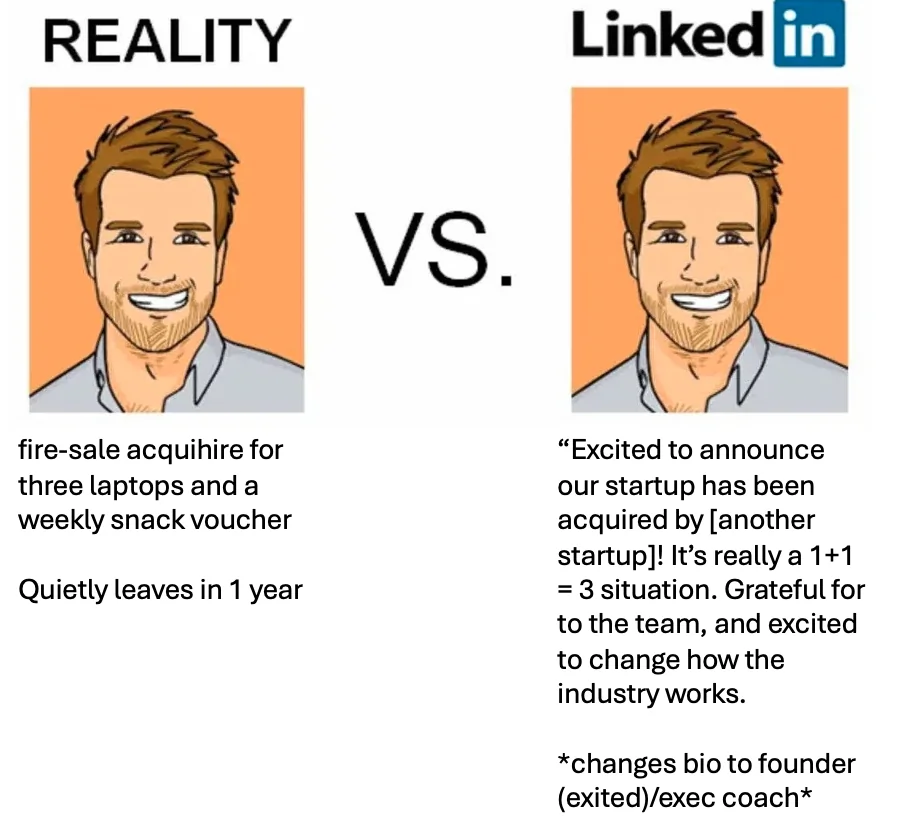
You’ll constantly feel the need to compare your company to their company. You’ll also feel the need to be “poasting”, and “building in public”. I just want to assure you that there are a lot of people building very killer businesses silently because their customers are not spending time on Linkedin. They’re keeping quiet, moving like lasagna, and doing so without posting every micro success online.

And the inverse of that, 90% of the people you talk to are at a job because it is a 9-5 that pays the bills. They absolutely do not care about your company or solving the problems as badly as you do. Most of them take on all the risk if something goes wrong and very little upside if things go right. That’s true of many of your employees, your partners, and the people you need to sell into.
They do not feel the urgency the way you do, and basically your entire job is to make them feel some sense of excitement and urgency to overcome apathy. You’ll need to come to terms quickly that for most people their job is just a job. In healthcare this tends to be more true especially if you’re a services business that employs people who have never worked at startups before.
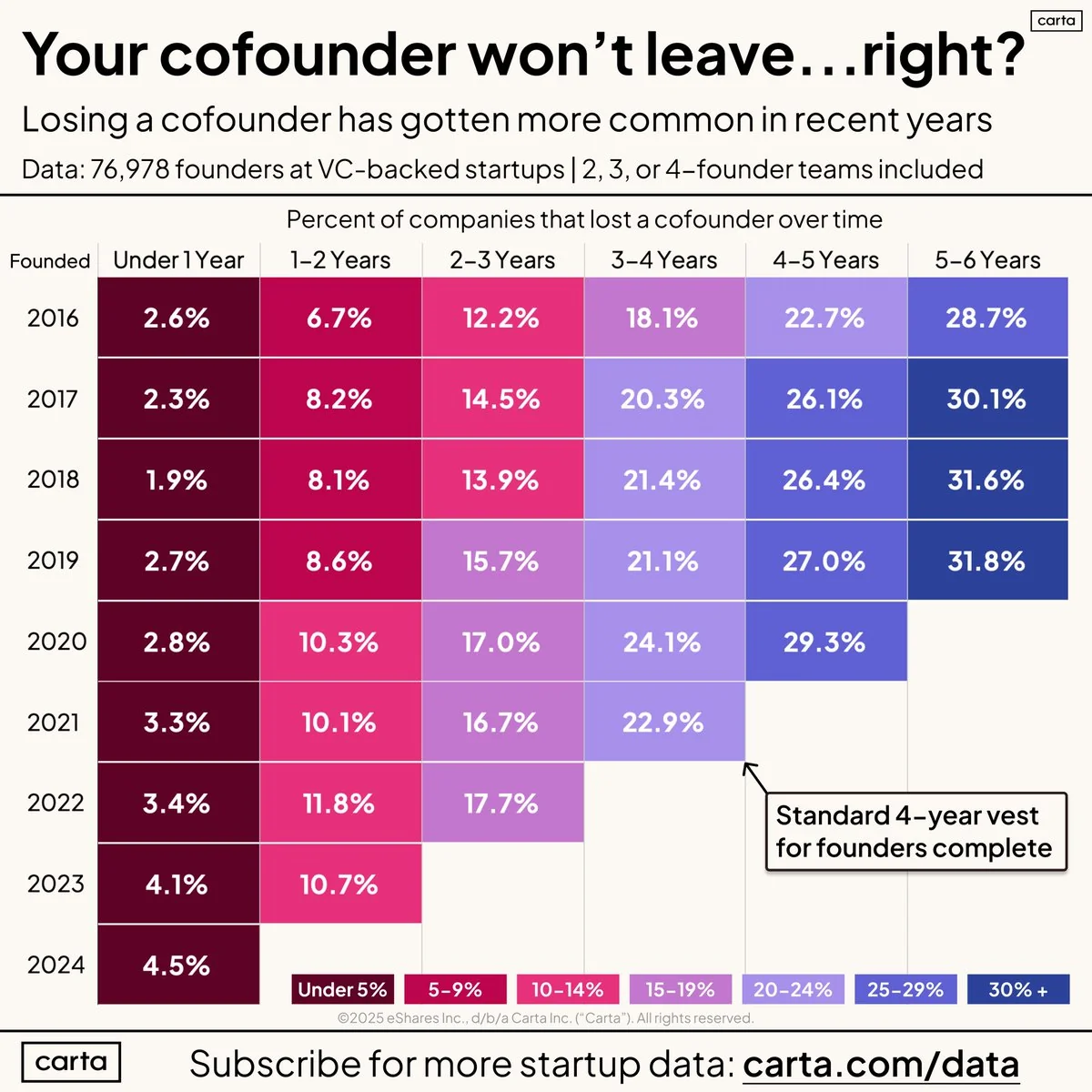
You’re Very Likely Going to Lose One of the Co-Founders
The running joke is that every startup has one “lost” co-founder. The one who was there at the start, maybe still owns a sizable chunk of equity, but left or was kicked out and they were lost to the sands of time.
A lot of times this is because:
You have co-founders with clear swim lanes that start overlapping, or you start hiring people with significant expertise that’s kind of doing the job of one of the co-founders. That co-founder gets relegated to “special projects” and then eventually everyone’s trying to figure out what that person actually does.
You have founders with an even equity split but suddenly one of the founders isn’t pulling their weight and they’re just constantly being guests on podcasts talking about how it’s “good for the company brand”. Resentment starts building here.
There’s a conflict in terms of the direction you want to take the company. One co-founder explicitly wanted to build a CONSUMER product, but you realize the only way to actually generate revenue is by billing CPT codes, so you start building for providers. A schism in the vision can cause an irreconcilable rift.
No One Cares as Much as You - It’s Just a Job for Everyone Else
You are the biggest champion of your own company. You have to get other people just as excited as you to care. Yes, when you’re doing the pitch for the 1,000th time and you start disassociating, you need to still be excited.
It is 100% a worthwhile exercise to go through very rigorous co-founder interviews (example here), even with someone you know really well. This at least helps identify issues up front + you can go back to reference this exercise if a potential situation you talked about comes up. Honestly I think people should do this in dating too, but y’all are not ready for that conversation.
Lawsuits and Legal Letters are Way More Common Than You’d Expect
One thing I didn’t really realize until spending time with founders is how many frivolous lawsuits you get when you start a company that are a total mental tax to deal with (especially when some of them name you personally).
Patent trolls claiming you’re infringing on an extremely broad patent they own
Copyright/trademark suits
Employee lawsuits that might seemingly have no basis
Privacy suits around the California Consumer Privacy Act (CCPA) that significantly stretch definitions
Cease and desists left right and center for things you didn’t even know were desistable
These can be all kinds of random. A founder friend had a payday lender come after them. One of their customers was supposed to get a refund from their company, that person had a payday loan they couldn’t pay back, and the lender realized the company was more likely to pay anyway, so they sued.
I think laws are important, obviously. But many of these are too small or not worth the cost of lawyering up. This forces the company to settle.
But I think in general it’s so bad for the startup ecosystem - it distracts companies, shortens their runway, and takes a mental toll on the founders. Just know that again, you’re not the only one dealing with it.
Get Used to Intertwining of Relationships and Sales
The reality of starting a company is that you are constantly going to be selling. And the reality is that in a lot of cases you're going to be leveraging your personal relationships in those sales.
When you're hiring, you're probably going to try and hire people you've worked with—friends, or at least people you want to have positive relationships with. But their livelihood is now tied to you delivering.
Your first enterprise customer is going to be a champion at a company that you've known previously. This is ESPECIALLY true in healthcare, where everyone is risk-averse and the only way to break through is by building trust on a personal level. That person is sticking their neck out for you, and the future of your relationship will be dependent on you delivering.
This is what can make the founder journey feel lonely; it can feel like it distorts relationships. I've definitely soured some relationships along the way, but it also feels AWESOME when you're winning with friends professionally.
There are Still a TON of Good Reasons to Do It
My editor (voice in my head) informed me that “this is kind of a bummer”. So I also wanted to say that it’s f***ing awesome to start something.
You deeply give a shit about what you’re doing, you actually feel good going into work, and every win is an emotional high.
Seeing a thing you willed into existence help people is awesome, especially when you talk to people and they’re ecstatic about what you’re building.
Winning as a team with your employees/partners is basically the closest you’ll get to feeling like you won the Superbowl.
Everyone awkwardly skates past this, but it’s awesome financially if things work out! In a regular job your exposure to the upside of the company doing well is relatively limited; it doesn’t get higher risk and higher financial reward than running the company. I’m trying to get rich enough that I have to track 181 days in a primary residence and my kids turn out maladjusted.
It is absolutely DEVASTATING to the haters when you’re winning. I keep a couple faces in the back of my head, you know who you are.
The last thing I’ll say is that don’t let anyone tell you what counts as founding a company. The number of times people have asked “when are you going to start something?” always surprised me. Yeah I'll start something, a fight.
If you do a thing, and someone pays you directly for it, you founded a business. It’s not any more complicated than that.
I want to hear from more of you that have been down the journey of starting a company in healthcare. What’s some founder advice or lessons you’d share with other healthcare founders reading this? The more specific, stories, and “not usually talked about” the better. I’ll keep you anonymous if you want.
Thinkboi out,
Nikhil aka. "6x exited founder (all failed)"