Most-cleared, most-strained
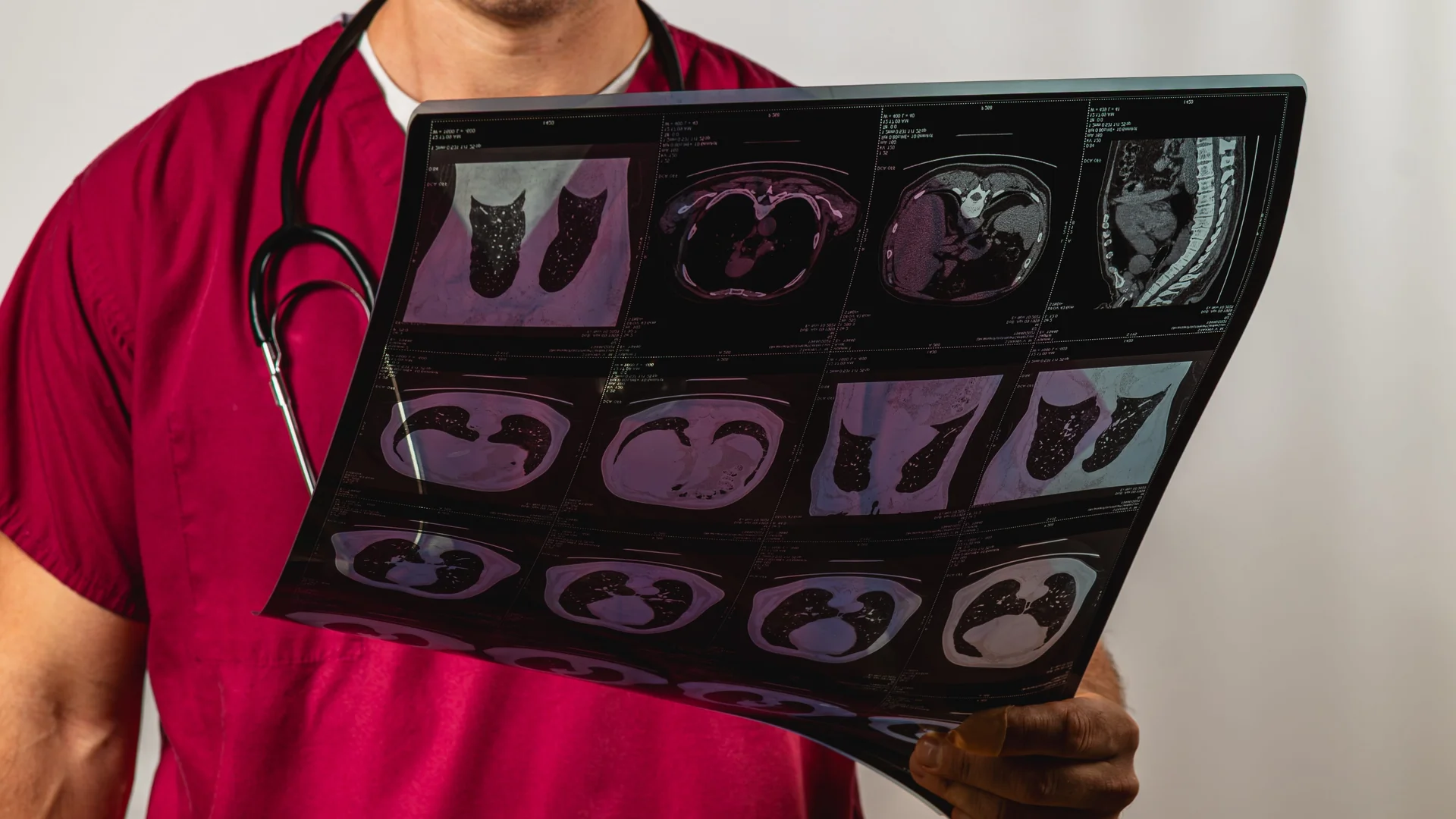
By the end of 2025, the FDA had cleared more than 1,000 AI-enabled devices for radiology — roughly three-quarters of every AI clearance the agency has ever issued. No other specialty is even close. And yet radiology is also the specialty with the deepest workforce squeeze, the most well-documented pilot-to-production cliff in healthcare, and a reimbursement system that still pays for the study, not the algorithm. Most-cleared, most-strained, and still mostly paid the old way.
The interesting question for the next decade isn't whether AI works in radiology. That argument is largely over. The question is what does radiology actually becomes when it does — when agentic systems are coordinating workflow across modalities, when foundation models are drafting reports before a human opens the case, and when "autonomous" has stopped being a thought experiment and started being a CE-certified product on a vendor marketplace.
Three shifts are doing most of the work. AI is moving from narrow tools to agents. Humans are moving from in-the-loop to on-the-loop to (for some categories) off-the-loop entirely. And the role itself is widening — from diagnostic service to strategic node in a system that increasingly runs on imaging. The HLTH.rad agenda at HLTH Europe this June is the field's first serious attempt to put all three conversations in the same room.
AI spreading its wings
For most of the last decade, radiology AI meant narrow tools doing a singular thing. An algorithm to flag intracranial bleeds, or pulmonary nodules. Another for breast density. Useful, sometimes excellent, but fundamentally passive in the workflow — they sat there waiting to be invoked, returned a finding, then went quiet. The radiologist did the connective tissue.
That model is breaking in two directions at once. The first is multimodal foundation models that go beyond simply “reading” the image to also read the priors, the lab values, the clinical notes, the protocol history, and produce a draft read that integrates all of that together. A domain-specific generative model trained on 8 million radiograph-report pairs recently demonstrated 95.3% sensitivity for pneumothorax and a 70.5% rate of reports accepted without modification — within striking distance of the 73.3% acceptance rate for human radiologist reports. The same model's outputs were preferred over both GPT-4Vision and radiologist-authored reports in 60% of cases.
The second direction is agentic. We’ve seen terminology migrating quickly from AI research labs into radiology lit. For instance, a 2026 scoping review identifies five distinct application themes for agentic systems in imaging, ranging from autonomous decision support to workflow orchestration. The shift is from tools that respond to prompts to systems that reason across inputs, sequence their own actions, and coordinate across PACS, RIS and EHR. Smarter, more intelligent, all wrapped together.
An agent that notices a pulmonary nodule on a routine CT, checks the priors, drafts the follow-up recommendation, queues the radiologist for sign-off, schedules the three-month follow-up, and flags the case to pulmonology. This is a very real trajectory, and prototypes already exist.
A thousand point solutions don't make a platform
The flip side of a thousand cleared algorithms is that no radiology department actually wants a thousand vendor relationships. Every new AI tool, in the old model, meant another integration, another contract, another security review, another dashboard. The procurement overhead of "more AI" started, somewhere around 2023, to outweigh the clinical benefit of any single tool.
The market noticed. The fastest-growing layer in radiology AI right now isn't a new algorithm — it's the orchestration platform that sits between the algorithms and the PACS. CARPL, deepc, Blackford, Aidoc's aiOS, DeepHealth's OS, Sectra's Amplifier Marketplace. Each is, in essence, the same pitch: one integration, one security framework, one point of support, access to a curated library of validated tools, with monitoring and governance built in. The marketplace model has quietly become the operative answer to the pilot-to-production cliff, because the cliff was really all about the cost of integration.
A consolidation has started, though. Sectra's acquisition of Oxipit in March 2026 is the signal worth watching as it pairs a PACS vendor with a deployed-at-scale autonomous AI product. The platform layer is edging toward an operating system, and we know that the people who own the operating system get to decide what runs on it. Anyone who read about Epic’s swallowing of the ambient AI scribe space last year will recognise this phenomenon…
Let’s get used to the questions we’re going to hear more and more of: which platform do we bet on, what governance do we wrap around it, and how do we keep enough optionality to swap components as the field moves? These questions don’t have a clean answer yet, which is why it's on the agenda this June.
What the human is actually for
For most of the last decade, the human-AI conversation in radiology has been binary: replacement or augmentation. The actual answer turns out to be a gradient.
Three modes now coexist in modern departments, often within the same shift. Human-in-the-loop is what most current AI looks like — the radiologist reviews every output, accepts or rejects every annotation, signs every report.
Human-on-the-loop is what's emerging, where the radiologist supervises an AI that runs continuously (protocol selection, acquisition optimisation, worklist prioritisation), intervening when performance drifts but not auditing every case.
Human-off-the-loop has just arrived, where defined low-risk categories are handled autonomously, with QA in the background and the radiologist owning only the exceptions. ChestLink, now part of Sectra, is the lighthouse in this last category: achieving 99.9% sensitivity for normal chest X-rays, autonomously clearing 40 to 80% of cases at deployed sites, no radiologist involved unless the AI flags uncertainty.
Philips' Future Health Index commentary has the most useful framing for what this means in practice: the radiologist's role increasingly resembles an attending overseeing residents. Not reviewing every read, instead supervising the system, catching drift, owning the exceptions. Their same survey found that two-thirds of radiologists flag liability as a top worry, which is the unresolved spine of all of this. The legal default treats the human signing the report
As the bottom of the pyramid automates, the top expands. The work that's left for the human is the work that's hardest to automate — multidisciplinary tumour boards, theranostic decision-making, complex interventional procedures, patient-facing consultation. Theranostics is the cleanest example. The PSMA-PET and Pluvicto pairing locks imaging and therapy into a single workflow; the radiologist isn't just diagnosing prostate cancer, they're selecting and dosing the radioligand that treats it. The radioligand therapy market is on track to roughly double by 2030. The same logic shows up in opportunistic screening: a CT ordered for one reason yields automated biomarkers for cardiovascular risk, osteoporosis, and sarcopenia that nobody asked for and nobody would have derived manually. Imaging becomes a population health tool, not just a diagnostic service. From gatekeeper to gateway, in the literal sense.
The HLTH.rad agenda in June reads, in retrospect, like a field collectively working out what to do with the new room it suddenly has — what to delegate, what to supervise, what to take on. The sessions on agentic AI and scaling sit next to the sessions on theranostics, integrated diagnostics, and economics for a reason. They're the same conversation. Radiology has spent a decade being the AI testbed for the rest of medicine. The next decade is about what the specialty does with that head start — and crucially, who's in the room when the decisions get made.