

Menopause is finally emerging as a health, workforce and investment priority. Yet the evidence, care pathways and innovation reaching women remain profoundly uneven, particularly across Africa.
Menopause is not a niche health issue. It is a life-course transition experienced by roughly half the population, often spanning several years and affecting health, wellbeing, family life and economic participation. The World Health Organization now describes it as a public-health and women's-rights imperative, a welcome shift for a phase of life that medicine has historically treated as an afterthought.
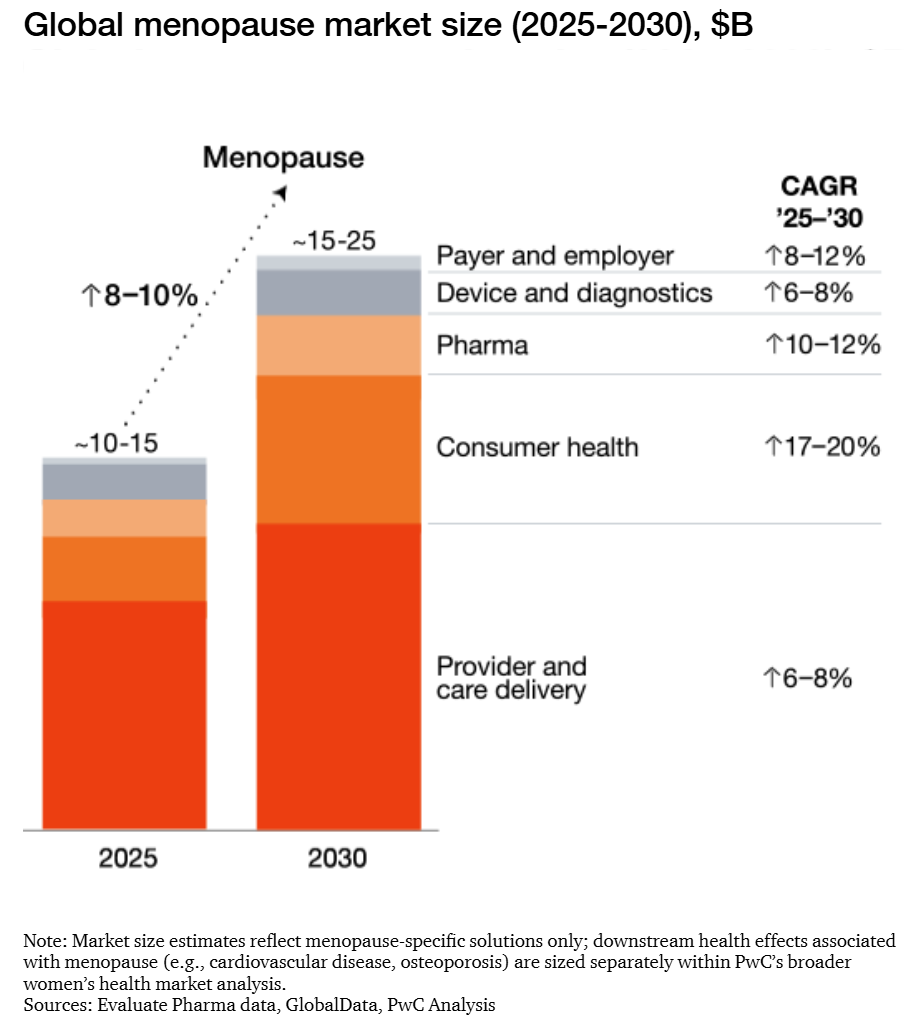
The scale of the opportunity is becoming harder to ignore. McKinsey estimates that addressing the menopause-related health gap could add approximately $120 billion to annual global GDP. PwC, looking at a different measure, estimates that menopause-specific products and services represent a $10–15 billion global market today and could reach $15–25 billion by 2030. One figure describes potential economic value; the other describes commercial market size. Together, they show that the human case and the economic case are beginning to converge.
Employers in wealthier markets are responding. PwC reports that 25% of large US employers offered or planned to offer enhanced or standalone menopause benefits in 2026, compared with 4% in 2023. In Great Britain, employers with at least 250 employees can already publish voluntary gender-equality action plans that include menopause support; subject to legislation, these are expected to become mandatory from spring 2027.
This is progress. But it is also a warning. The models now defining menopause innovation—specialist virtual clinics, employer-sponsored benefits, diagnostics and consumer platforms—have largely been built around the purchasing power, health systems and data environments of high-income markets. For millions of women elsewhere, the more immediate questions are more fundamental: where to find trusted information, how to recognise symptoms and whether an affordable path to competent care exists at all—not which menopause benefit to choose.
The urgency will grow as Africa ages. The World Health Organization projected that the population aged 60 and older in sub-Saharan Africa would rise from about 67 million in 2025 to 163 million by 2050. Menopause therefore belongs not only in reproductive-health policy, but also in the continent's healthy-ageing, noncommunicable-disease and health-system agendas.
Africa's menopause gap is visible in the data we do, and do not, have
There is no defensible single prevalence figure for 'menopause symptoms in Africa'. The continent contains 54 countries and extraordinary variation in language, culture, income, health systems and care-seeking. A 2024 global meta-analysis estimated that 64.4% of women in the included African studies experienced hot flushes, the highest pooled regional estimate, but statistical heterogeneity was extreme and the certainty of evidence was rated very low. The number is a signal of potentially substantial burden, not a continental prevalence rate.
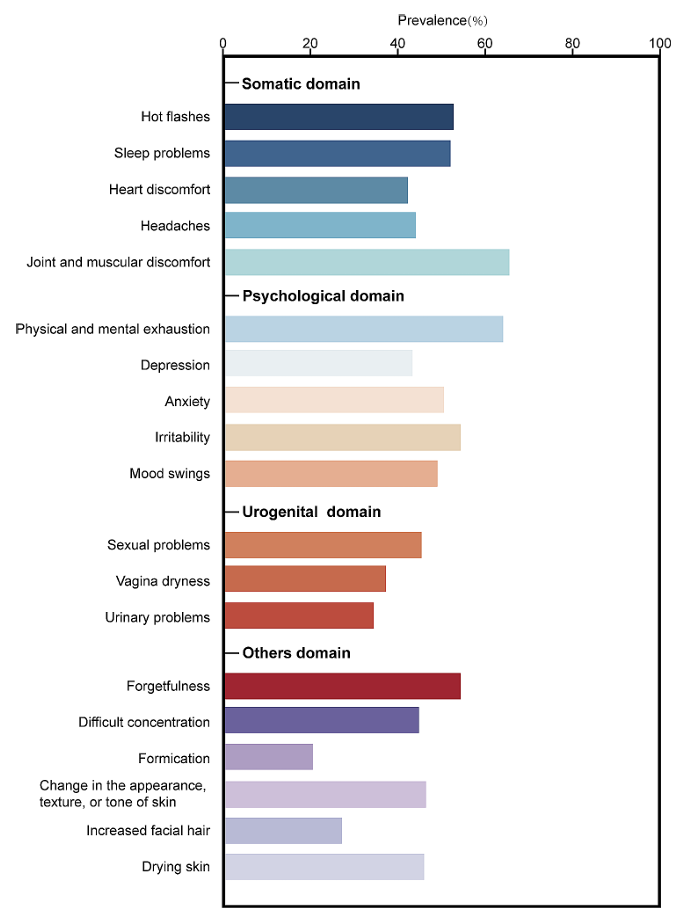
Country studies make the care gap more tangible. A 2024 facility-based study of 296 women aged 40–60 attending three gynaecology clinics in Addis Ababa reported that 89.9% experienced at least one menopausal symptom; physical and mental exhaustion affected 55.1%, and hot flushes 54.7%. None of the participants reported using menopausal hormone therapy. Because this was a clinic sample, it should not be generalised to Ethiopia as a whole. It does, however, show the scale of unmet need that may present at the point of care.
Kenya provides another lens. At the country's first National Menopause Conference in August 2025, Supreme Court Judge Njoki Ndung'u described brain fog that led her to fear early-onset dementia or Alzheimer's disease. She travelled abroad for medical checks and was eventually diagnosed with menopause; on returning home, she said she found few specialists and a clinical system still oriented primarily around maternal care.
Her experience is powerful, but it should not be mistaken for national epidemiology, because Kenya does not yet have it. A 2024 survey of 304 women who voluntarily participated at an urban community health-education event found musculoskeletal pain in 74.1% and mood swings in 45.8% of respondents. The study was useful as an early signal, but it was not nationally representative. That distinction matters. Without representative data, we cannot reliably quantify how symptoms vary by age, geography, income, language or access to care.
Kenya and Ethiopia are not outliers in this respect. A 2025 review identified 252 menopause studies across 41 low- and middle-income countries, yet only 4% were nationally representative. Evidence on symptom severity and burden was particularly scarce, while poor knowledge, provider-training gaps, cultural stigma and structural barriers were recurring findings. The menopause gap is therefore not only a treatment gap. It is an evidence gap that determines whose symptoms are recognised, whose needs shape clinical guidance and which solutions attract investment.
The consequences of this evidence gap can persist for years. Although established menopause treatments already exist, research on drug development estimates that a new medicine typically takes 10–15 years to move from initial discovery to patients. That long timeline reinforces the need to act on two fronts: investing in research and product development for the future, while improving education, navigation, referral and follow-up for women who need support today. Digital services cannot replace clinical research, but they can begin addressing immediate barriers to care and generate locally relevant evidence while longer-term innovation continues.
Affordability compounds the problem. As one market-level illustration, selected private Kenyan pharmacy listings reviewed in September 2026 ranged from approximately KES 3,300 for a pack of oral estradiol to more than KES 21,000 for some combination patches. These are not equivalent regimens, and the real cost of care can also include consultations, investigations and additional medicines. The figures should not be extrapolated across Africa, but they show how quickly treatment can become inaccessible when paid for out of pocket.
Employment structures also shape what can scale. The International Labour Organization's modelled 2024 estimates put informal employment among employed women in sub-Saharan Africa at 89.5%, compared with 83.5% among men. Employer-sponsored menopause benefits may be valuable, but they cannot be the primary access model when most women work beyond the reach of conventional corporate benefits.
This is not a story about African health systems as a single bloc, nor should evidence from Addis Ababa or Nairobi be collapsed into a claim about women from Lagos to Lusaka. It is a story about a recurring hierarchy within health systems: menopause often sits behind fertility and maternal health, and behind conditions with more visible political constituencies. Country-level evidence must remain locally specific. The pattern it reveals, however, deserves continental attention.
Why WhatsApp could be part of the answer
The case for WhatsApp is not that a chatbot can replace a clinician. It is that a familiar conversational channel can become a practical front door to information, structured symptom assessment, navigation and follow-up if it is connected to a clinically governed pathway behind it.
Evidence from other health conditions shows both the potential and the limits. In a hospital-based randomised trial in Yaoundé, Cameroon, 316 pregnant women were assigned to routine antenatal care or routine care plus 12 weeks of nurse-moderated WhatsApp education. The trial reported that completion of the recommended eight antenatal contacts was 20.1% in the intervention group and 7.0% in the control group. The adjusted likelihood was 2.65 times higher, but the absolute improvement was 12 percentage points. Participants already owned smartphones and used WhatsApp, so the result should not be generalised to every population or setting.
South Africa's Shesha chatbot offers a different lesson. It was designed to give household contacts of people with tuberculosis their test results, preventive-treatment information, reminders and personalised support over WhatsApp, while reducing repetitive follow-up work for community health workers. Its published development study reported encouraging early user acceptance, but outcome evaluation was still under way. Shesha demonstrates feasibility and thoughtful service design, not yet proven clinical effectiveness.
Malawi's Ministry of Health showed that WhatsApp could also be deployed as part of a national public-health response. Its COVID-19 chatbot recorded 347,117 interactions between May 2020 and May 2023. Yet these were interactions, not unique users; the system was unavailable on 38% of study days; and people were much more likely to report sensitive symptoms through human-operated telephone services. The implication is important: digital reach and human trust are complementary, not interchangeable.
Digital access is also uneven. GSMA's 2025 analysis estimates that women in sub-Saharan Africa are 29% less likely than men to use mobile internet. Kenya's Communications Authority, meanwhile, reported aggregate smartphone penetration of 83.5% in June 2025. Both statistics matter: one exposes a regional gender gap, while the other shows the infrastructure opportunity in a specific market. Neither proves that midlife women own, control or can privately use a smartphone. Device sharing, data costs, digital literacy, geography and language must shape the service model.
The opportunity is a connected care pathway and evidence engine
A 2023 scoping review found only 12 eligible publications on health chatbots in Africa and concluded that the available evidence was insufficient to establish whether they were effectively supporting health across the region. Rural populations, local languages, user trust, privacy, regulation and robust evaluation remained substantial gaps. The appropriate conclusion is not that conversational health tools have failed. It is that the sector is still learning where they work, for whom and under what safeguards.
For menopause, the strategic opportunity is larger than symptom education. A well-designed conversational service could help women recognise patterns over time, prepare for clinical conversations, identify red flags, navigate to licensed professionals and remain engaged after referral. With appropriate consent and governance, longitudinal symptom data could also begin to correct the geographic evidence gap that currently limits research, service design and investment.
In practice, such a pathway could address several connected problems. Locally adapted education and structured symptom check-ins could help women recognise possible menopause-related changes and understand when they should seek professional support. Navigation could then connect them to the most appropriate available resource—whether a trained community health worker, pharmacist, teleconsultation or in-person clinician. For women in rural areas, this could reduce unnecessary travel and help prevent them from dropping out between recognising a problem and reaching care.
The same channel could support continuity after that first contact. Women could record how symptoms change over time, receive reminders linked to an agreed care plan and confirm whether referrals have been completed. A structured symptom history could also help clinicians make better use of short consultations, particularly where specialist capacity is limited. The objective would not be to automate diagnosis or prescribing, but to remove avoidable friction around care and make scarce clinical time more effective.
At a health-system level, appropriately consented and de-identified data could help identify where symptoms, unmet demand, referral failures and provider-training needs are concentrated. This could support better service planning and more representative research. However, access to care should never depend on a woman agreeing to contribute her information to research, and small or geographically specific datasets must be managed carefully to reduce the risk of re-identification.
But the guardrails are not optional. WhatsApp uses encryption to protect messages as they travel between participants, but encryption alone does not make a service clinically or legally safe. Once information reaches a healthcare organisation, authorised staff, technology providers or connected systems may be able to process it. Information may also be exposed through shared phones, visible message notifications, device backups or weak internal access controls. Women must therefore be told clearly who will receive their information, where it will be stored, how long it will be retained and whether it may be used for care, service improvement, research or marketing.
Privacy by design should be built into the pathway from the outset. This means collecting only the information necessary for the stated purpose; using discreet notification wording; applying role-based access, audit trails and retention limits; and giving women practical ways to correct, export or delete their information. Consent for care should be separated from consent for research or secondary data use. A data-protection impact assessment should also be completed before launch, alongside clear policies for third-party processors, security incidents and cross-border data transfers. In Kenya, health information is treated as sensitive personal data under the Data Protection Act, and the Office of the Data Protection Commissioner has issued specific guidance covering health-data processing. Alternative telephone or in-person routes should remain available for women who do not own or privately control a phone.
What this means for global health innovation
The next phase of women's health innovation cannot be built only around consumers with employer benefits, specialist access and the ability to pay privately. Nor can solutions developed in North America and Europe simply be exported and relabelled for emerging markets. Different health systems, cultures, languages, care-seeking behaviours and patterns of phone access require different models.
African markets offer the opportunity to build from those realities: trusted and accessible entry points; networks of licensed clinical and community partners; clear referral and escalation pathways; and a shared evidence architecture that preserves country-level differences. Kenya can be an important proving ground, but no single country should serve as a proxy for the continent. In this model, WhatsApp is not an innovation on its own. Innovation is the pathway it makes possible.
A credible model should therefore be judged not primarily by chatbot engagement or message volume, but by whether women recognise symptoms earlier, receive the correct level of support, complete referrals, remain engaged with care and experience better health outcomes. WhatsApp may provide the entry point, but trust, clinical governance, affordability and continuity will determine whether the pathway works.
Menopause is finally entering the global health and investment conversation. The test for the sector is whether that attention produces another premium category for women already well served, or a genuinely global model that reaches women the existing system has historically reached last.