The Future of Personalized (Astronaut) Health
In the extreme environment beyond Earth’s protective atmosphere, space explorers face a set of challenges to their health and performance. There’s radiation exposure, bone and muscle loss, dealing with altered fields of gravity, and more to overcome for a safe mission and healthy crew. Being so far from Earth is its own challenge to caring for spaceflight participants, calling for innovative solutions to ensure the health and safety of space travelers. And because dealing with a health issue is so difficult in space, prevention is key.
Prevention requires having minute-by-minute health information at your fingertips; paired with information about your past health history and the exposures that you experienced (like exposure to radiation and lunar dust), a dashboard can inform on your current health status and predict medical events.
Even on Earth, transferring historical health data between organizations and healthcare providers can be challenging. It is rare for a person to walk into a clinic and instantly grant the provider access to their medical history. The same problem could happen beyond Earth's surface, as private space exploration increases and astronauts go from a government space station to a private lunar rover or habitat on the Moon.
With its robust experience in space health research with both governmental and commercial spaceflight providers, the Translational Research Institute for Space Health (TRISH) is looking for a way to address this issue for space too.
TRISH is an applied space health research catalyst that funds disruptive, high-impact scientific studies and technologies to equip astronauts for deep space exploration. The Institute is supported by the NASA Human Research Program and led by Baylor College of Medicine, along with consortium partners Massachusetts Institute of Technology and California Institute of Technology.
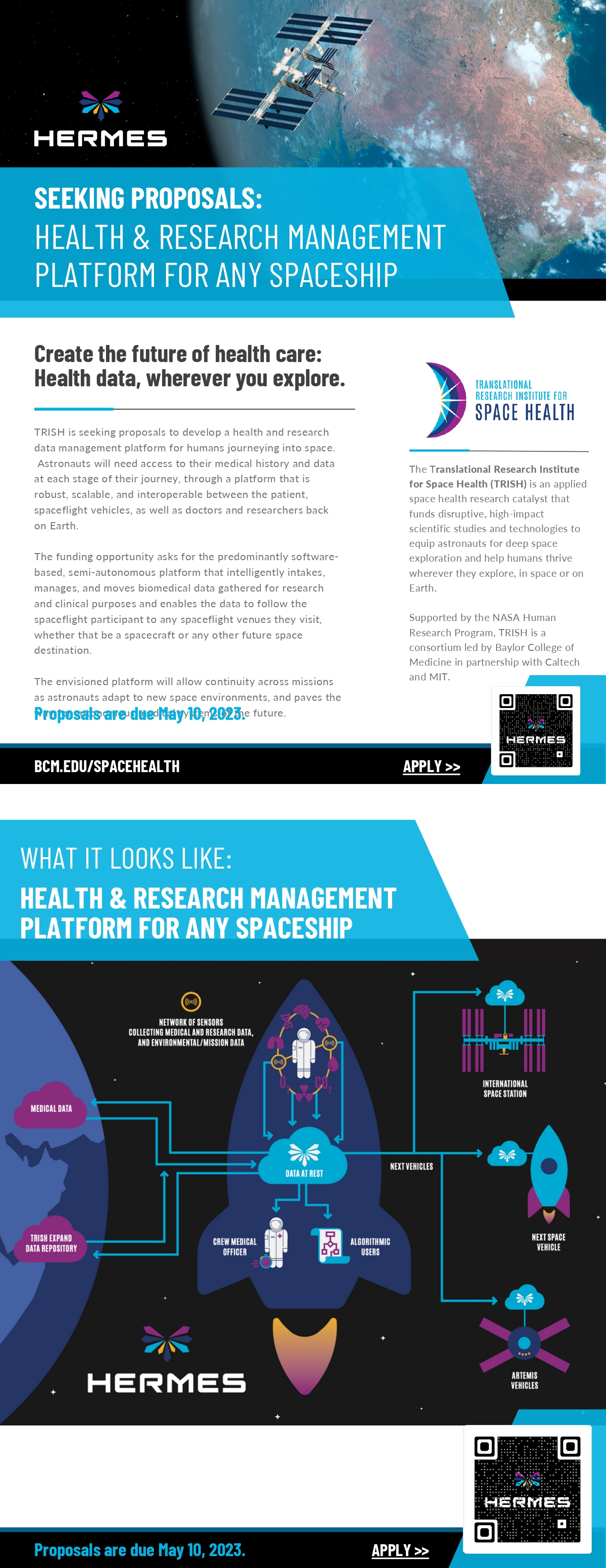
The group recently announced it is seeking proposals to develop a health and research data management platform for space explorers. TRISH sees it as a critical step towards developing a spaceflight habitat or vehicle-independent autonomous medical system.
The winning product will be a robust, scalable, interoperable platform that can be used in different spaceflight vehicles (think: a space vehicle flown by NASA, Blue Origin or SpaceX, etc.) that will enable access to and use of a spaceflight participant's health data by medical crew in space, doctors on Earth, other researchers, and the individual themselves. The predominantly software-based, semi-autonomous platform will intelligently intake, manage, and move biomedical data gathered for research and clinical purposes.
“TRISH needs a health and research data management system that will follow and serve the astronaut patient at each stage of their journey,” said James Hury, TRISH’s deputy director and chief innovation officer. “On Earth, these systems are bound by billing processes. In space, we need an incredible amount of flexibility paired with immediate usability of all the health, research and spaceflight environmental data collected during each mission.”