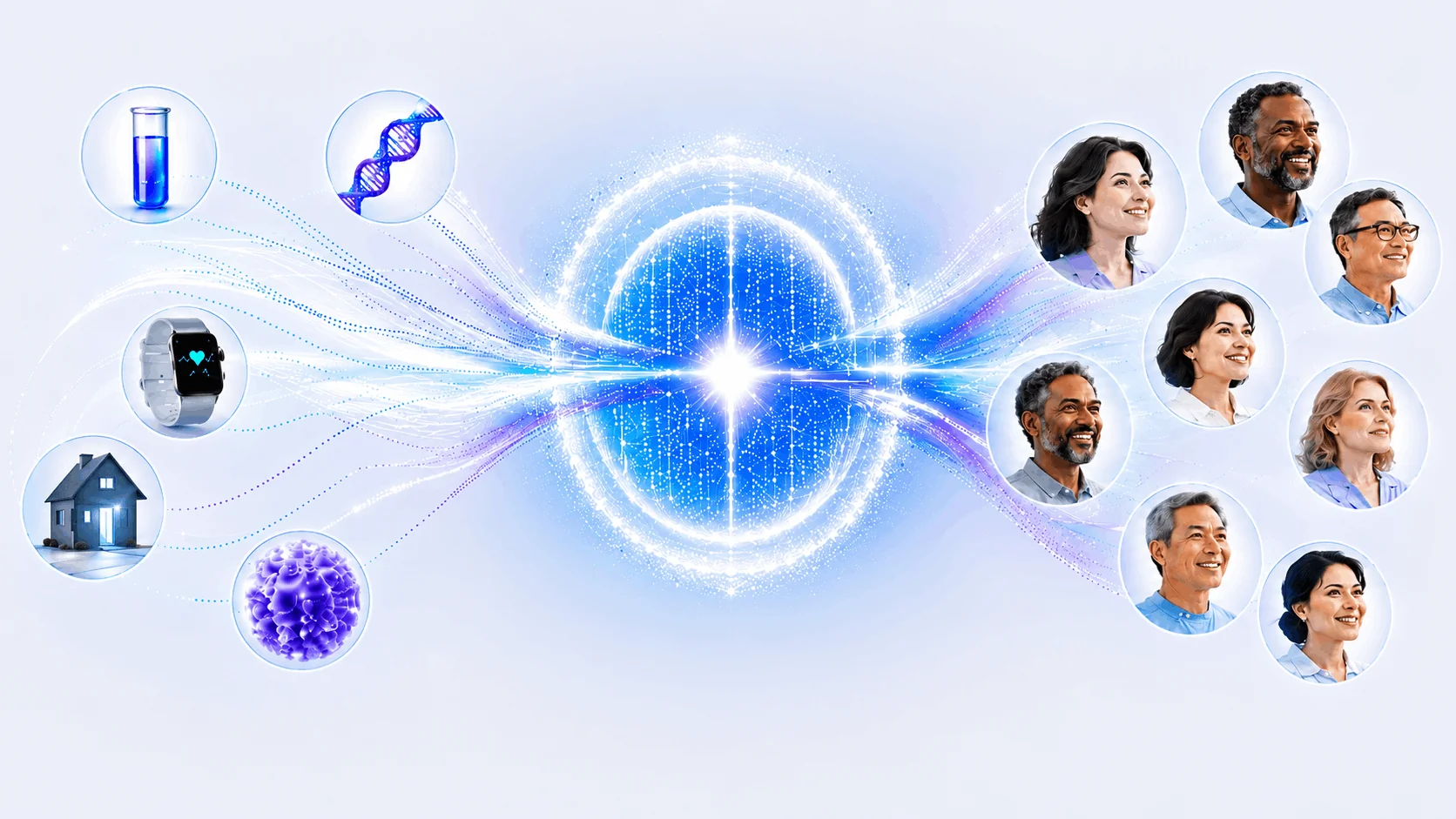

For years, I have believed diagnostics is much more than a test result. Diagnostics is the intelligence layer of healthcare.
The CDC once estimated that roughly 70% of medical decisions are based on diagnostic testing. Today, that influence is likely even higher as diagnostics expands across biomarkers, genetics, home testing, wearables, medication response, and real world data.
The diagnostic intelligence layer is powered by the diagnostic data streams shown below, with AI serving as the connective layer that turns these inputs into earlier insight, better decisions, and more personalized action.
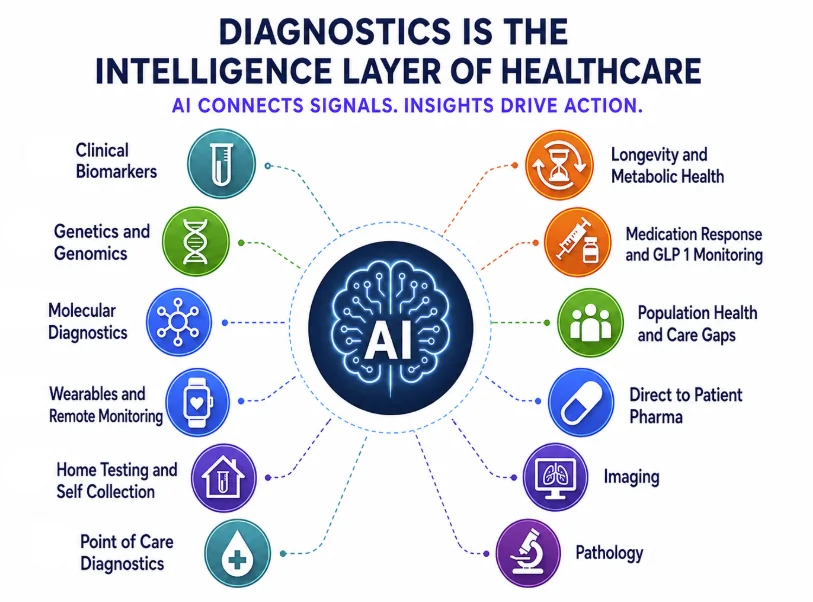
These signals help determine whether a patient is diagnosed, treated, monitored, referred, screened, enrolled, or followed more closely. They make risk visible. They help detect disease earlier, guide therapy, measure progress, and personalize care.
Every week, we are seeing new AI announcements across healthcare, from drug discovery and clinical workflow to diagnostics, genomics, wearables, and patient engagement. The important shift is that so many of these developments are diagnostics related, accelerating diagnostics from a supporting function into a front door of care.
This is a paradigm shift. AI is making diagnostics more visible, more connected, and more central to how healthcare operates, giving it the opportunity to become the intelligence layer that helps predict, prevent, personalize, and act earlier.
AI Is Unlocking the Full Value of Diagnostic Data
Diagnostic data becomes more powerful when connected to the broader healthcare data ecosystem. Lab results, genomics, imaging, wearables, and home testing provide the signals, while medication history, claims, lifestyle patterns, and social context help turn those signals into more complete insight.
AI can make this data more connected, useful, and actionable by identifying patterns over time, linking signals across modalities, flagging risk earlier, and translating complexity into clearer clinical context.
This is where the opportunity becomes much bigger. Diagnostics is increasingly helping answer questions about what risk is emerging, which patient needs attention, whether treatment is working, and what should happen next.
The most exciting opportunity is enabling earlier, smarter, and more actionable diagnostics.
The value is earlier risk detection, prevention, intervention, care gap closure, therapy selection, medication optimization, disease monitoring, patient engagement, and health optimization.
That is how diagnostics moves to the front of healthcare.
Multi cancer early detection is a powerful example of this shift. Blood based screening assays are being developed to detect signals associated with multiple cancers, often before symptoms appear. Lighthouse Lab Services recently framed MCED as a potential new era for population scale cancer screening, with implications for clinical laboratory growth, molecular infrastructure, reimbursement, and proactive cancer detection.
The opportunity is not only a new test category. It is a glimpse into how diagnostics can move upstream, where AI, liquid biopsy, genomics, bioinformatics, and lab workflows come together to identify risk earlier and guide the next step in care.
Biomarkers, Longevity, and GLP-1s Are Moving Diagnostics Upstream
One of the biggest opportunities sits inside routine clinical biomarkers.
The basic lab result is far more powerful than most people realize. Patients are already turning to AI tools to better understand what their lab results may mean and what questions to ask next.
This is becoming even more important as healthcare moves toward prevention, longevity, metabolic health, and personalized optimization. People want to understand their biology earlier. They want to know how their metabolism is responding, how inflammation is changing, how hormones are shifting, how sleep and activity are affecting their health, how nutrition is impacting performance, and how risk can be reduced before disease progresses.
AI can help turn routine lab data into longitudinal intelligence.
Instead of looking at isolated values, AI can help interpret patterns over time. It can help connect biomarker changes to lifestyle, medication, weight loss, sleep, activity, nutrition, clinical history, and genetic predisposition. It can help identify subtle changes that may suggest increasing risk. It can help prioritize what matters most.
This is where diagnostics becomes the foundation for precision prevention.
Diabetes, kidney disease, cardiovascular disease, liver disease, thyroid disease, autoimmune conditions, metabolic dysfunction, inflammation, and hormonal changes often reveal themselves through patterns long before they become major clinical events.
AI can help the system notice those patterns earlier. That creates value across health systems, payers, employers, pharma, consumers, and patients.
The rise of GLP-1 medications is one of the clearest examples of how diagnostics, data, and monitoring are becoming central to modern healthcare.
GLP-1s are changing the conversation around obesity, diabetes, cardiometabolic risk, and long term health. They are also creating demand for baseline metabolic testing, kidney and liver markers, lipid evaluation, A1C, insulin resistance markers, nutritional status, muscle health, side effect monitoring, adherence, and long term maintenance.
AI can help personalize this journey. It can support better patient selection. It can track biomarker response. It can identify gaps in monitoring. It can recommend follow up testing. It can help distinguish meaningful clinical improvement from surface level change. It can help connect medication use with lifestyle, nutrition, behavior, and long term health outcomes.
A GLP-1 program becomes much stronger when it is connected to diagnostic intelligence. The medication may be powerful, but the care model becomes more complete when it is supported by biomarkers, patient engagement, coaching, monitoring, and longitudinal data.
This is one of the most important examples of where diagnostics, pharma, consumer health, and AI are beginning to converge.
Longevity is creating a similar pull.
Consumers are no longer waiting until they feel sick to ask questions about their health. They want to understand how they are aging, metabolizing, recovering, sleeping, and changing their risk profile.
This demand is pushing diagnostics into a more proactive role.
Biomarkers are becoming the language of prevention. Genetics is becoming a lifelong context layer. Wearables are creating continuous signals. Home testing is making access easier. AI is helping connect all of it into a more understandable, personalized picture.
That is a major shift for healthcare.
The future of prevention will depend on our ability to interpret signals earlier and help people act before small risks become major conditions.
Genetics Is Becoming a Lifelong Health Asset
Genomics has always carried one of the biggest promises in healthcare, helping us understand inherited risk, disease predisposition, metabolism, drug response, and how prevention can become more personalized.
A genome is not just a test result. It is a lifelong data asset, especially when whole genome sequencing (WGS) becomes easier to access, interpret, and apply over time.
This is why infrastructure and scale matter. Platforms like Gene by Gene help make sequencing more accessible, while AI helps turn genomic data into actionable intelligence.
A recent study published in Science found that the intrinsic heritability of human lifespan may be about 50% after accounting for external causes of death such as accidents, infections, and violence. That does not mean genetics determines destiny, but it does suggest that inherited biology may play a larger role in longevity than many previous estimates implied.
For diagnostics, this is important because genetic insights become much more valuable when they are connected to biomarkers, lifestyle, medication response, wearable data, and longitudinal health patterns.
AI can help support variant interpretation, phenotype matching, risk stratification, pharmacogenomics, rare disease diagnosis, oncology decision support, reproductive health, nutrigenomics, and population genomics programs. It can also help identify when genetic information should be used in care.
The future of genetics will be connected to biomarkers, medication history, wearable trends, family history, metabolic health, longevity data, and clinical workflow. That is where precision health becomes real.
Wearables Are Creating Continuous Health Signals
Wearables are changing the way people understand their health.
The front door of healthcare is increasingly the home, the phone, the watch, the ring, the band, continuous glucose monitors, connected blood pressure devices, at home test kits, and remote monitoring platforms.
Consumers are generating health signals every day (see image below). These signals are becoming part of the diagnostic ecosystem.
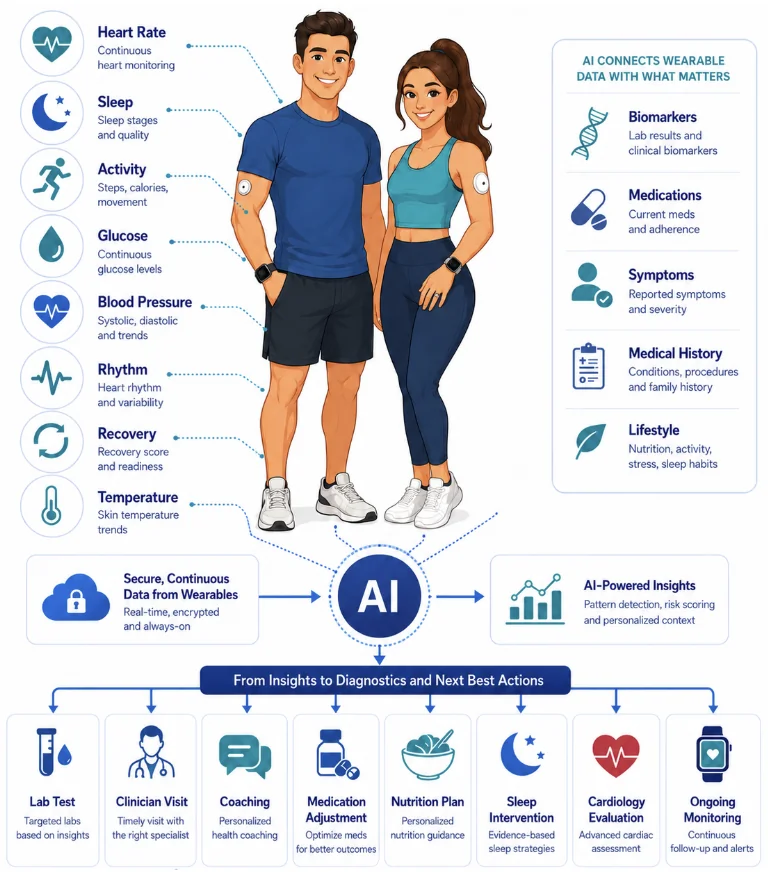
A wearable may identify a trend. Diagnostics can help explain what the trend means. A device may flag a pattern. A lab test, genetic test, clinical evaluation, medication review, or imaging study may help turn that pattern into action.
This is where AI adds value. AI can help distinguish noise from meaningful physiologic change, connect wearable data with biomarkers, medications, symptoms, medical history, and lifestyle patterns, and guide the next best step.
That next step may be a lab test, a clinician visit, a coaching intervention, a medication adjustment, a nutrition plan, a sleep intervention, a cardiology evaluation, or ongoing monitoring.
Home Testing and Logistics Are Expanding Access
Home testing adds another important layer.
At home sample collection, mobile phlebotomy, direct to patient testing, retail access, employer programs, payer led outreach, disease specific screening campaigns, and remote monitoring are expanding the reach of diagnostics.
Home testing can reduce friction, reach patients who delay or avoid in person care, support gaps in care programs, enable population health screening, make longitudinal monitoring easier, and support clinical trials, pharma programs, and chronic disease management.
Direct to consumer testing is also part of this shift. Consumers are increasingly comfortable ordering tests, tracking biomarkers, and using results to ask better questions about prevention, longevity, hormones, nutrition, metabolic health, and medication response. AI can make this model more personalized, easier to understand, and better connected to follow up when needed.
Home testing works at scale when the logistics are excellent.
The Dot Corp is a strong example of the infrastructure behind this shift, combining custom kitting, fulfillment, member communications, systems integration, and operational scale to support home testing, population health, and gaps in care programs. As diagnostics moves closer to the patient, logistics becomes a strategic part of the diagnostic intelligence layer.
This is where diagnostics becomes infrastructure. The test itself is one piece. The full value comes from access, logistics, interpretation, engagement, and follow up
Direct to Patient Pharma Is a New Frontier for Diagnostics
One of the most important shifts I am watching is the movement of pharma closer to the patient.
Pharma companies are increasingly thinking about direct to patient (DTP) engagement, education, screening, adherence, treatment monitoring, and long term outcomes. This is especially relevant in areas like obesity, cardiometabolic disease, oncology, rare disease, women’s health, autoimmune disease, kidney disease, and preventive health.
Diagnostics sits at the center of this shift. If pharma wants to reach the right patient earlier, diagnostics is the pathway.
A biomarker can identify risk. A genetic test can clarify eligibility. A home test can reduce access friction. A wearable can monitor response. A lab panel can track safety and efficacy. A diagnostic pathway can help move a patient from awareness to action.
AI can help pharma make these programs more intelligent. It can support patient identification, risk stratification, education, test routing, adherence monitoring, outcome tracking, and real world evidence generation. It can help personalize patient journeys while supporting responsible, clinically grounded engagement.
Labs, home testing companies, fulfillment partners, digital health platforms, genomics companies, and data companies can all play a role in helping pharma move from broad awareness campaigns to more targeted, test enabled, patient centered care models.
This is where diagnostics becomes a bridge between pharma innovation and real world patient access.
This expands the role of diagnostics from screening to awareness, therapy initiation, monitoring, adherence, outcomes, and evidence generation.
The Future Is Multimodal Diagnostic Intelligence
The future of diagnostics is connected intelligence.
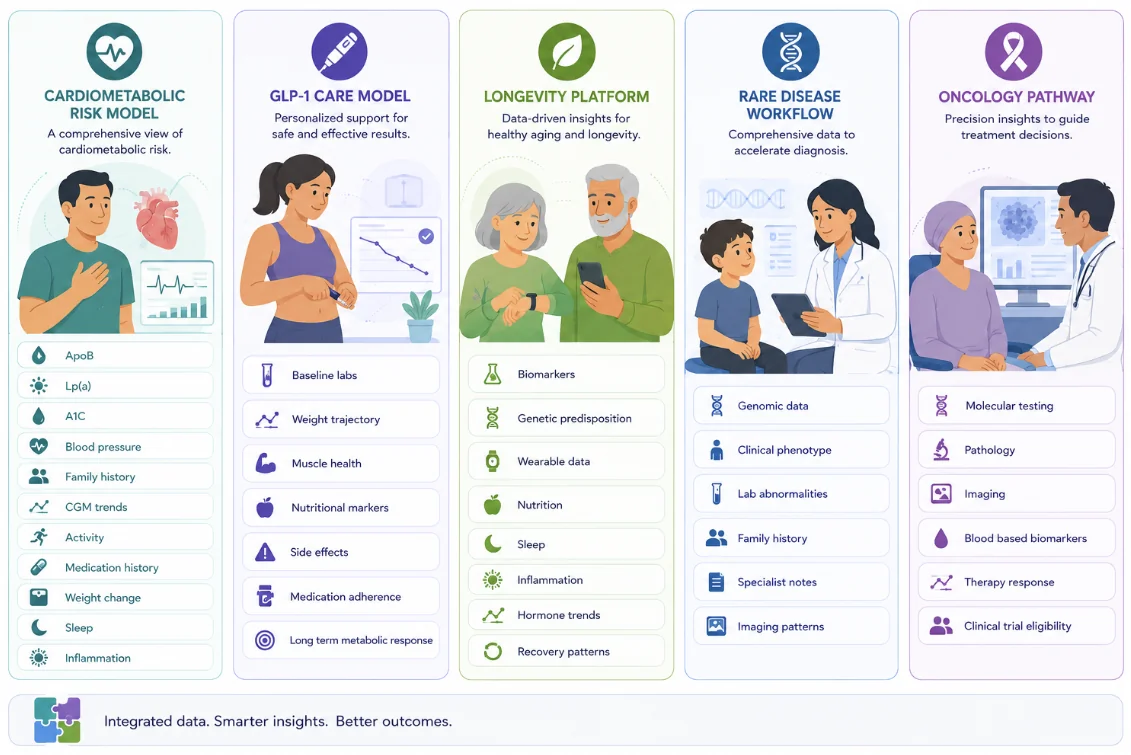
A patient’s story is no longer shaped by one result alone. It is shaped by many signals: lab results, genetics, biomarkers, wearables, medication response, home testing, lifestyle patterns, clinical history, family history, imaging, and pathology.
AI becomes powerful when it connects these signals into a clearer picture and helps turn complexity into action.
The next era of diagnostic AI combines technology and operations. A powerful AI insight only matters if it can be trusted, explained, operationalized, measured, and connected to follow up. This is where the real world of healthcare matters: access, specimen collection, logistics, lab operations, reporting, interpretation, reimbursement, patient communication, and clinical workflow.
This is also where labs have a major opportunity to move higher in the value chain. Labs sit on some of the most valuable clinical data in healthcare. With AI, they can become true clinical intelligence partners, helping health systems identify risk earlier, payers close care gaps, pharma identify appropriate patients, clinicians choose the right test, and patients better understand their data.
The value of diagnostics is no longer only in the test itself. The value is in the intelligence created from the test, the timing of the intervention, and the action that follows.
This is also why engagement platforms play a critical role. As diagnostics moves into the spotlight, the industry needs trusted places to understand trends, hear from thought leaders, connect ideas, and accelerate collaboration. Boombostic Health is helping fill that role by elevating diagnostics through podcasts, market insights, and curated industry conversations. At a time when AI, biomarkers, genomics, wearables, home testing, and pharma engagement are converging, platforms like this can help bring the right people and ideas into the same room.
The digital front door becomes much more powerful when it is connected to diagnostic intelligence. A patient may enter the system because of a biomarker trend, a wearable signal, a genetic risk, a home test, a medication response, an AI generated alert, or a longitudinal pattern that suggests the need for action.
That signal may come before symptoms, before hospitalization, before disease progression, and before the patient realizes there is a problem.
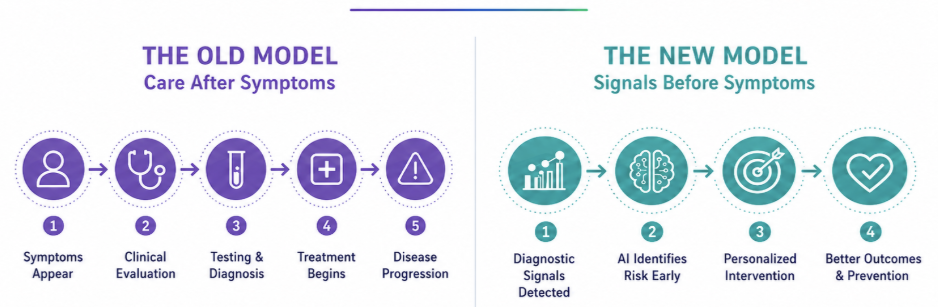
That is the promise of moving diagnostics upstream.
Diagnostics is already the intelligence layer of healthcare. AI can make that intelligence connected, scalable, personalized, and actionable.
If we get this right, diagnostics becomes the front door, decision engine, and connective layer for a more proactive healthcare system.
That is where the future of healthcare begins, with diagnostics as the intelligence layer, now amplified by AI and impossible to ignore!