

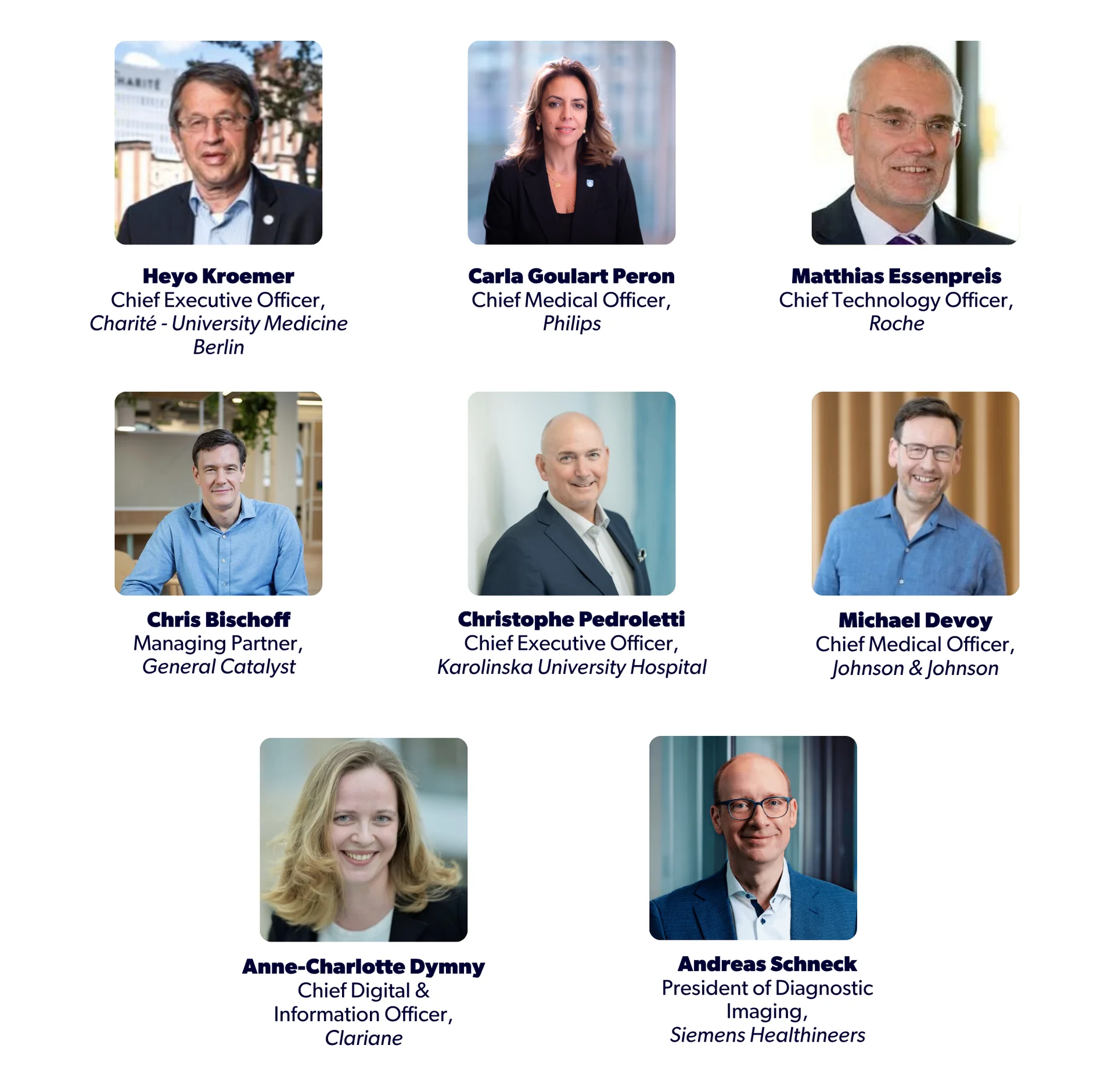
The HLTH Insights Council (EU) brings together an invitation-only group of senior leaders from across health systems, life sciences, medtech, investment and policy to help shape HLTH's year-round programming, editorial agenda and Executive Masterclasses.
Meet the Council
At its inaugural meeting, members were asked to consider a single question:
What will define European healthcare by 2030?
To explore that question, the Council assessed seven forward-looking statements on two dimensions: certainty (how likely they believed each statement was to materialise by 2030) and impact (how significant the consequences would be if it did).
The scatterplots quickly revealed three distinct patterns. Some forces attracted broad consensus. Others exposed genuine disagreement. Most interestingly, several highlighted a growing gap between where healthcare leaders believe Europe needs to go and what current systems are equipped to deliver.
Over the course of the discussion, the conversation moved well beyond emerging technologies. Instead, it focused on the organisational, financial and structural changes required to translate innovation into better care. AI, workforce, fragmentation, consumer healthcare and reimbursement were all discussed through the same lens: not what is possible, but what is practical.
From AI capability to healthcare readiness
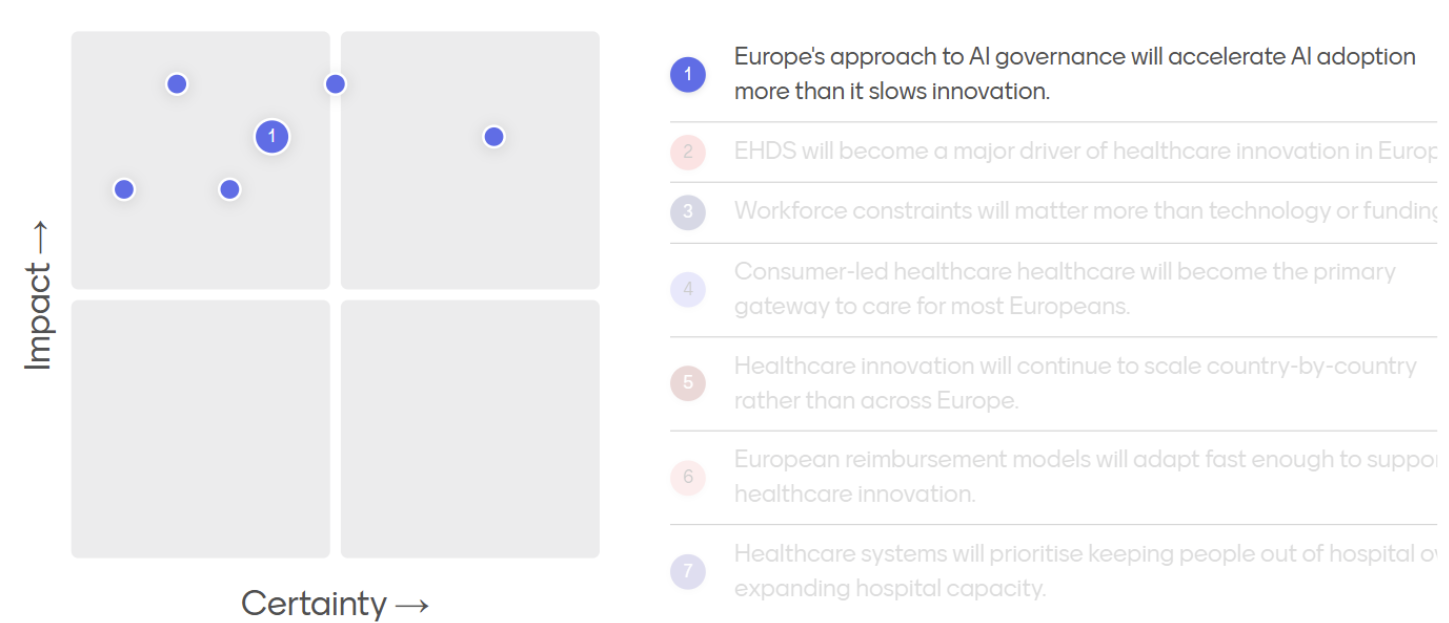
The discussion on AI began with what appeared to be a familiar question: will Europe's approach to regulation accelerate adoption or slow innovation?
It quickly became clear that the room was asking a different question altogether.
Several Council members challenged the assumption that Europe's biggest AI challenge is finding the right balance between innovation and regulation. Instead, they questioned whether the industry is measuring the right thing in the first place.
As one Council member observed:
"Trust comes from outcomes, not regulation."
That distinction fundamentally changed the discussion.
Rather than debating whether Europe has too much regulation, members questioned whether current governance frameworks place too much emphasis on controlling the process of developing AI and too little on understanding how it performs once deployed in clinical practice. Unlike traditional medical technologies, AI continues to learn, evolve and interact with increasingly complex workflows after implementation. Several members suggested that healthcare may need new approaches to evaluating AI in the real world rather than relying solely on pre-deployment assessment.
The same tension emerged in the discussion on the European Health Data Space (EHDS). There was broad agreement that shared health data has the potential to transform research, innovation and care delivery. Confidence was considerably lower when it came to implementation.
One member argued that Europe's challenge is not legislation itself. Much of the legal framework already exists. The greater obstacle lies in how individual countries interpret, implement and operationalise it. While the rules may be shared, attitudes towards data sharing, organisational maturity and digital infrastructure differ significantly across Member States. As a result, members increasingly described EHDS not as the innovation itself, but as the infrastructure that makes future innovation possible.
When workforce becomes the driver of innovation
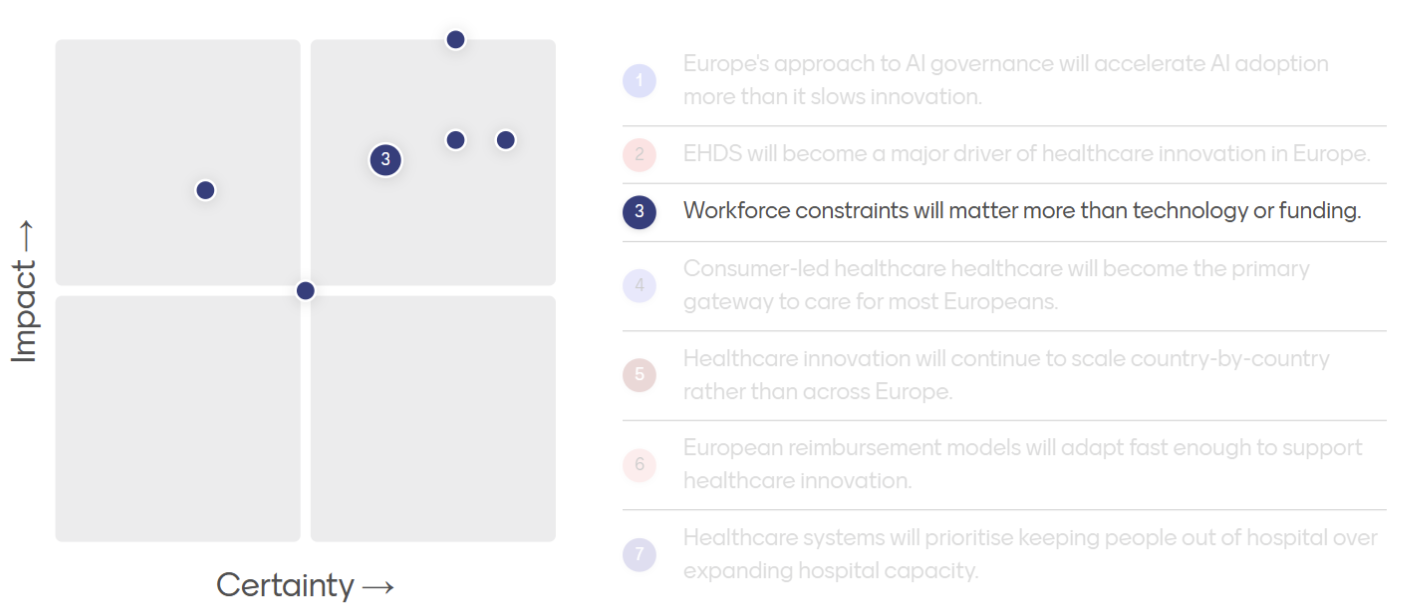
If one discussion revealed a genuine shift in thinking, it was workforce.
The conversation quickly moved beyond staff shortages and recruitment. Instead, members described workforce pressures as the force that will determine whether almost every other healthcare transformation succeeds or fails.
One participant put it bluntly:
"Workforce constraints will only be solved through technology."
It was one of the strongest statements made during the meeting, not because it suggested technology alone is the answer, but because it reflected a growing belief that Europe may simply be running out of alternatives.
Several members argued that demographic pressures are increasing exponentially while workforce growth is not. Under those conditions, AI becomes less a strategic investment and more an operational necessity. The discussion challenged the increasingly common narrative that AI will replace clinicians. Instead, technology was consistently framed as the mechanism that enables clinicians to continue delivering care within systems facing growing demand and finite capacity.
At the same time, members were clear that technology cannot solve the challenge in isolation. Prevention, earlier diagnosis, redesigned care pathways and new models of care all need to evolve alongside AI if healthcare systems are to remain sustainable.
Perhaps the most significant shift in the discussion was that workforce was no longer viewed as a constraint to innovation. Instead, it was increasingly described as the force that will accelerate it. As pressure continues to mount, health systems may adopt new technologies not because they want to, but because they have few alternatives.
Scaling innovation across a fragmented Europe
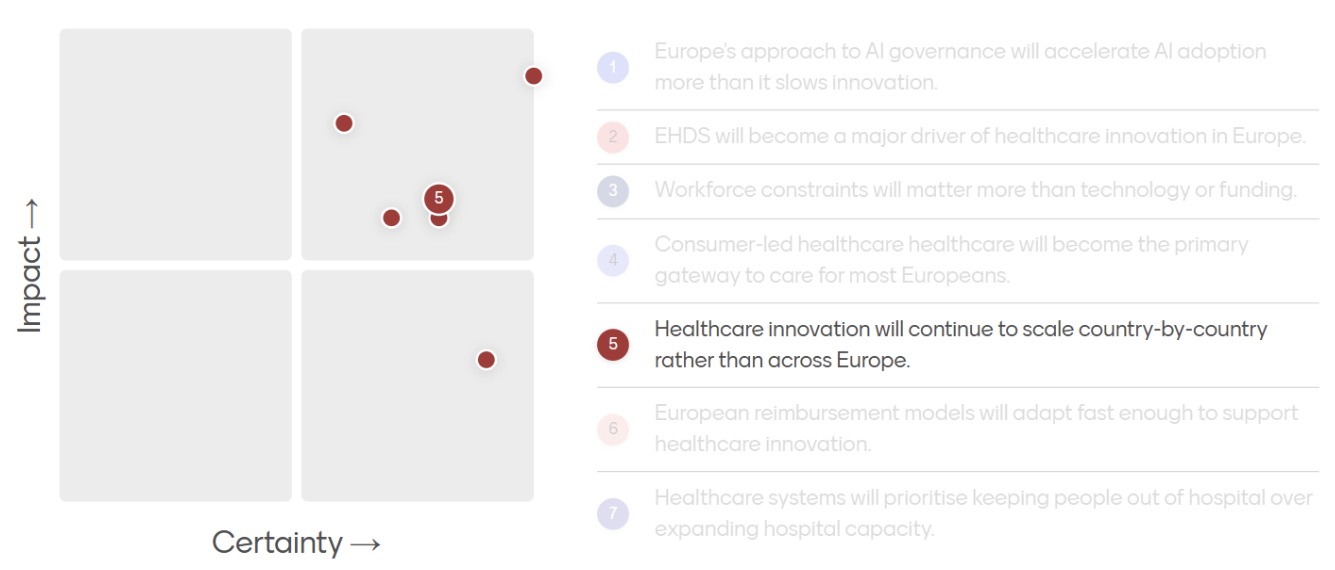
Few discussions felt more distinctly European than fragmentation.
There was little disagreement that Europe continues to produce world-class healthcare innovation. The greater challenge lies in what happens next. While successful ideas emerge across the continent, scaling them beyond national borders remains considerably more difficult than developing them in the first place.
As one Council member summarised:
"America innovates. Europe regulates. China scales."
The remark resonated around the room, not as a criticism of regulation itself, but as a reflection on Europe's ability to translate innovation into widespread adoption.
As mentioned before, several members challenged the assumption that regulation is the primary barrier. Much of the legislative framework already exists. The greater obstacle lies in how individual countries interpret, implement and operationalise it. Healthcare delivery and procurement remain fundamentally national, creating very different environments for innovation despite increasingly common European policy frameworks.
The discussion offered few simple solutions. While there was broad agreement that greater collaboration is essential, there was much less certainty about how Europe gets there. Innovations that prove successful in one country continue to face different reimbursement models, procurement pathways and implementation requirements in the next, making continent-wide scale the exception rather than the rule.
Perhaps the most unexpected conclusion was that economics, rather than policy, may ultimately become the strongest force for integration. As workforce shortages deepen and financial pressures continue to mount, members argued that healthcare systems will increasingly be forced to consolidate services, standardise approaches and collaborate more closely. Change may arrive not because governments choose it, but because existing models become increasingly difficult to sustain.
Consumer healthcare is redefining the front door to care
Consumer healthcare produced one of the most thought-provoking discussions of the meeting.
What began as a conversation about digital health quickly expanded to include prevention, diagnostics, GLP-1 therapies, wearables, AI assistants and direct-to-consumer health platforms. Members broadly agreed that consumers will play a much more active role in managing their health, often well before engaging with the formal healthcare system. As technology becomes more accessible and health data easier to interpret, consumers are increasingly taking ownership of their health and expecting healthcare to be as immediate, personalised and convenient as other digital services.
The discussion became more nuanced when members considered what happens after that first interaction.
As one Council member observed:
"Consumers want more tests."
Greater access to diagnostics and health information has the potential to improve prevention and identify disease earlier, but it also creates new challenges. Several members questioned whether health systems are prepared for the downstream consequences of a population that is increasingly informed, but not always better guided. More testing can also mean more false positives, more referrals and greater demand on already stretched services.
Rather than debating whether consumer healthcare will continue to grow, the conversation focused on the role healthcare systems will need to play as it does. The emerging opportunity lies not simply in providing care, but in helping patients interpret, validate and act on an expanding volume of health information. The challenge for Europe's health systems is whether healthcare can evolve quickly enough to support consumers.
Incentives will determine the pace of change
The final discussion began with reimbursement but quickly evolved into a much broader conversation about the future sustainability of European healthcare.
There was agreement that technologies capable of supporting prevention, earlier diagnosis, remote monitoring and hospital-at-home models already exist. The challenge lies in creating funding models that reward those approaches rather than continuing to incentivise treatment and activity. As one member observed, organisations are increasingly encouraged to invest in prevention, yet many never realise the financial benefits. Reduced hospital admissions often generate savings elsewhere in the system, leaving those making the investment with the cost, but not the return. Without reimbursement models that reward long-term outcomes rather than short-term activity, members questioned how quickly innovation can realistically scale.
As one Council member summarised:
"These are no longer healthcare decisions alone. They are societal decisions."
That observation fundamentally changed the direction of the discussion.
Members began questioning not only how healthcare should be funded, but what healthcare systems should ultimately prioritise. As increasingly sophisticated therapies continue to improve outcomes while also carrying unprecedented costs, difficult questions around affordability, resource allocation and value become unavoidable. One participant reflected on the growing proportion of healthcare expenditure concentrated in the final weeks of life, arguing that decisions about what healthcare systems choose to fund can no longer be viewed as purely clinical. They increasingly represent societal choices about where finite resources deliver the greatest benefit.
Perhaps more than any other discussion, this highlighted that the next phase of healthcare transformation depends not only on better technology, but on the willingness to rethink how innovation is valued, funded and rewarded.
What HLTH Takes Forward
The inaugural HLTH Insights Council (EU) demonstrated that Europe's healthcare leaders are asking a different set of questions than they were even a few years ago. The conversation has moved beyond whether innovation is possible and towards how health systems can create the conditions for it to scale. Across AI, workforce, consumer healthcare, reimbursement and care delivery, the discussion repeatedly returned to the practical realities of implementation and the structural changes required to support it.
These discussions will now directly shape HLTH’s Executive Masterclasses, virtual programming and in-person events throughout the year. The themes identified by the Council will inform the conversations we convene, the leaders we bring together and the questions we continue to explore with our community.
Watch the session here.