

Our patients may look more “complex” on the claim—but are they actually sicker?
A new Blue Cross Blue Shield Association analysis found that hospitals are coding more inpatient stays as complex, without a corresponding increase in selected measures of treatment intensity. BCBS points to AI-assisted coding as a possible driver, but the data can’t tell us whether every additional diagnosis reflects better documentation or overstated complexity.
I don’t think we have a clear answer yet. More complete documentation can help us physicians get paid appropriately for care we already provide. But it doesn’t, by itself, show that we’re delivering better care at a lower cost.
The same distinction applies to insurers. AI can help them scrutinize claims and challenge payment faster without necessarily making those decisions more clinically sound.
This is the AI billing arms race: hospitals invest in tools to capture and defend revenue, while insurers invest in tools to scrutinize and contest those claims. Both sides can improve their bottom line without demonstrating a benefit to patients.
In this Huddle Trends report, I’ll break down the new BCBS data, how both sides are building their AI capabilities, and what would need to change for this race to produce more than better billing and faster disputes.
The New Data: More Complexity, Similar Care
I covered an earlier BCBS analysis in How AI Documentation Tools Are Making Upcoding Worse. That report highlighted rising postpartum anemia coding without a corresponding rise in transfusions. This new September white paper examines the bigger inpatient trend, then digs into major bowel procedures.
First, a quick billing explanation (which you can learn more about in my Healthcare 101 course).
Hospitals generally receive a bundled payment for an inpatient stay based on its diagnosis-related group, or DRG.
Certain secondary diagnoses can move the same admission into a higher-paying category because they signal greater complexity and expected resource needs. For example:
- DRG 193: Simple pneumonia and pleurisy with MCC (Major Complication or Comorbidity).
- DRG 194: Simple pneumonia and pleurisy with CC (Complication or Comorbidity).
So documenting acute blood-loss anemia alongside simple pneumonia and pleurisy can change reimbursement, even if management itself is unchanged. BCBS calls these diagnoses “bump codes.”
Across the Blue system’s inpatient claims, the share classified as complex rose from roughly 37% in early 2023 to 40% by late 2025. BCBS estimates that increased coding intensity added $942 million in claims costs over two years. About $653 million—roughly 70%—was associated with secondary diagnoses moving cases into higher-paying categories (“bump coding”), representing 55,158 additional complex cases relative to its 2023 baseline. Blue Cross Blue Shield
These are BCBS’s estimates of incremental payments. They are not an audited tally of fraudulent claims or a direct measurement of spending caused by AI. But the estimates come amid growing adoption of AI coding tools.
The Bowel Surgery Example
For major bowel procedures, the share of claims in the highest-complexity category increased from 20.2% to 22.7% between 2023 and 2025. BCBS attributes $60.8 million in incremental claims costs to coding shifts in this DRG family.
The diagnoses driving those shifts included acidosis, hyponatremia, acute posthemorrhagic anemia, and malnutrition. These are familiar conditions to us physicians—and conditions that software scanning labs and notes might help identify. An abnormal lab value alone, though, does not establish a clinically meaningful, reportable diagnosis. A patient whose sodium is 133, compared with a baseline of 136, is technically hyponatremic, but you wouldn’t necessarily act on it if that level is more or less their baseline.
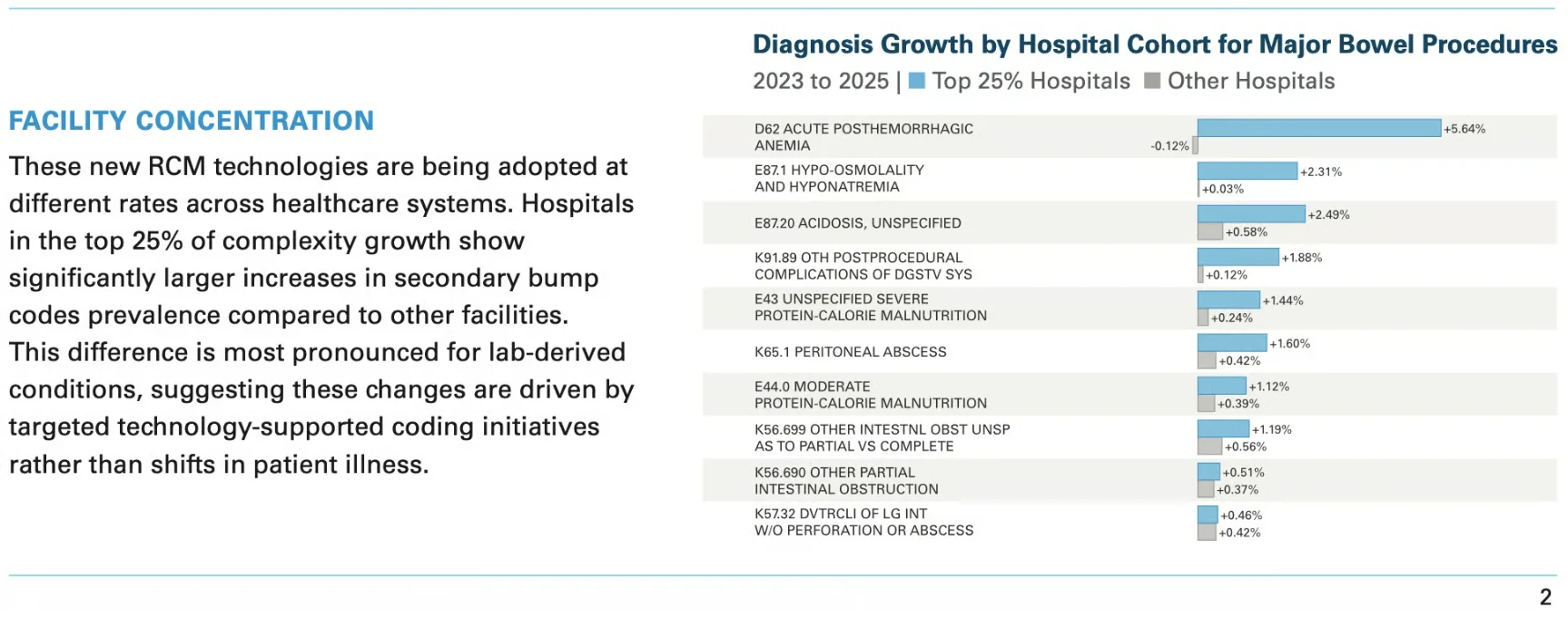
Source: BCBS
The more interesting comparison is between hospitals. In 2025, hospitals in the top quarter of coding-complexity growth classified 75.6% of bowel cases as complex, compared with 65.0% at other hospitals. Yet several measures of resource use were similar or lower:
- ICU use: 11.5% versus 13.2%.
- Transfusions: 3.6% versus 3.9%.
- Median length of stay: four days in both groups.
The overall mismatch is what BCBS calls “clinical discordance”: more complexity on the claim without a comparable increase in selected measures of care. Anemia, again, is a good example. High-growth hospitals coded posthemorrhagic anemia in 13.7% of cases versus 9.9% elsewhere, but among patients with that diagnosis, transfusion rates were lower: 16.9% versus 19.3%.
The analysis did not test whether these differences were statistically significant and cannot establish causality. So be skeptical, especially because BCBS has a financial stake in this story. Insurers have a reason to publicize rising hospital payments, just as hospitals have a reason to publicize denials and delayed reimbursement.
More complete coding could also be correcting longstanding underdocumentation. If we were treating these conditions all along but failing to capture them, payment could increase without treatment changing. That is different from adding unsupported diagnoses to inflate a bill.
BCBS identifies a relationship worth investigating, but the analysis does not establish how much reflects better documentation, differences in patient populations, inappropriate coding, or AI’s contribution. Sorting that out requires clinical record review and a stronger comparison of AI adopters and non-adopters.
The Conundrum: Both Sides Have a Reason to Invest
From a hospital’s perspective, investing in AI makes sense. Tools that review records can help translate care into documentation, codes, and claims that meet payer rules for reimbursement.
As I explained in my article on revenue cycle management, RCM is the tool connecting the patient encounter to payment. AI can help that tool capture missed diagnoses, correct billing errors, and appeal denials. Recovering true revenue and reducing manual work are reasonable goals. In an HFMA survey analyzed by Guidehouse, 88% of respondents said claims disagreements prevented timely, full payment. That’s not proof that insurer AI caused the problem, but it helps explain why providers want better tools to respond.
From the insurer’s perspective, investing in AI also makes sense. More complete coding can mean higher payments, and not every submitted claim is accurate or every requested service necessary. Tools that identify unsupported charges or low-value care have a role, provided their decisions are clinically sound.
Prior authorization reviews care before it happens while claims review examines payment after care is delivered. Different processes, but both give insurers opportunities to scrutinize spending and providers reasons to strengthen their documentation and responses.
The same payment is revenue to the hospital and an expense to the insurer. Better provider-side tools create an incentive for stronger payer-side scrutiny, which creates an incentive for better provider-side appeals. Neither side wants to be the one still doing this manually.
The incentives also depend on who’s paying whom. As a policy brief in npj Digital Medicine explains, insurers may challenge higher hospital claims while benefiting from more complete diagnosis capture in Medicare Advantage, where documented risk can increase their payments from CMS. Whether providers share in those risk-adjustment gains depends on their contracts.
So, AI may reduce the work required for each transaction while making it easier to generate more disputes. Both organizations can justify the investment without showing that patients receive better care or that total administrative spending falls.
Provider AI
As basic scribe transcription becomes a commodity, vendors need another reason for hospitals to pay. Increasingly, that reason is revenue. Having AI write notes is one thing, but having it to capture the diagnoses and code complexity that support reimbursement is another. The npj Digital Medicine policy brief describes this as competition moving “after the transcript.” That helps explain why scribes, coding tools, and revenue cycle platforms are increasingly sold together.
These tools do different jobs. An ambient scribe drafts the encounter note. Coding and clinical documentation integrity tools help find supported diagnoses and billing codes. RCM platforms handle the next steps: submitting claims, correcting errors, and pursuing payment when insurers push back. Investors see the opportunity. Candid Health recently raised $120 million to expand its AI-powered RCM platform, which aims to reduce billing errors and denials and speed reimbursement.
Less paperwork and more accurate payment are benefits we like. But as I explored in How Ambient AI Scribes Are Changing Medical Coding Intensity, capturing more complexity is not the same as delivering more value. The business case becomes especially easy to sell when a tool can recover revenue.
Payer AI
Insurers are investing in the other side of that transaction. UnitedHealth reportedly committed $1.5 billion to AI in 2026, spanning internal operations and software products. That is not a prior authorization budget, but it shows the scale of the investment.
Cigna has already shown its response to higher coding. Their R49 policy permits one-level reductions to selected higher-level office visit claims, targeting providers with patterns of higher coding for routine services compared with peers. The policy alone does not establish that AI makes those adjustments, but it shows how payers can push back on the revenue providers hope to capture.
AI could also help insurers approve appropriate care faster, not just challenge payment. UnitedHealthcare has announced plans to eliminate 30% of its remaining prior authorization requirements by year-end. Whether this actually translates into meaningfully easier access remains TBD.
WISeR: When the Government Is the Payer
CMS’s WISeR pilot is testing AI-assisted review for selected services in traditional Medicare across six states. The Electronic Frontier Foundation (EFF) sued for access to records about vendor contracts, accuracy testing, and oversight. This was a Freedom of Information Act lawsuit seeking transparency—not a lawsuit to shut down WISeR.
In September, EFF released roughly 1,000 pages of CMS records obtained through that litigation. The documents describe technical failures, miscommunication, and lengthy delays. One request remained unanswered after 83 days, although the reported wait reflects the full request pathway, not just a vendor’s processing time.
Dashevsky’s Dissection: What’s the Endgame?
It’s obvious why both sides are investing in their respective AI tools. Hospitals want to get paid appropriately, insurers want to control spending, and we physicians want less paperwork. But, taking a step back, will all of this do good for healthcare as a whole. Will it benefit patient care? Will it lower healthcare costs? Better workflows do not automatically mean lower total costs. Recovering revenue or reducing payments can make an AI tool worth it for its buyer without demonstrating a benefit to patients.
The question is what happens once the other side catches up. The npj Digital Medicine policy brief, which I mentioned above, raises a plausible scenario: early coding gains get offset by tighter audits, downcoding, or lower rates at contract renewal. We could end up buying increasingly sophisticated tools just to maintain our position like we’re running on a treadmill, while smaller practices struggle to keep up. We should watch out for this.
Capitated payments, though, could make a different kind of AI investment more attractive: identifying who’s likely to deteriorate and helping us intervene before they do. I’ve explored versions of this in How Decision Latency Slows Emergency Department Flow and Tom by Lumeris: The AI Platform Rethinking Primary Care at Scale. These tools aim at earlier clinical action and proactive primary care, respectively. When organizations bear responsibility for total spending and outcomes, preventing an avoidable admission can become more financially valuable than documenting another diagnosis. These approaches still need to demonstrate better outcomes and lower total costs.
In summary, I want AI to help us document accurately, get appropriate care approved, and spend less time fighting over payment. That requires clinician review of what gets coded, transparent and appealable payer decisions, and measuring access, outcomes, and total administrative burden—not just collections or avoided payments. Both sides can justify better software. The harder question is whether we are building a better system.