

Link to original post here.
15-second Take (TL;DR)
Healthcare staffing agencies are essential middlemen connecting hospitals with temporary clinical staff, but their high costs and impact on care continuity raise questions about sustainability. Understanding how they work—and why hospitals can't easily replace them—matters for anyone navigating workforce challenges in healthcare.
The Middlemen
Nurses across New York City are striking, but hospitals still need to operate. Who fills the nursing slots? Staffing agencies (and residents—but that's not the point of this article).
Staffing agencies have been on my mind ever since an emergency medicine physician advised me in medical school to never work for a hospital or private practice—just do locum work because you make so much more money. Then the pandemic hit, triggering a massive exodus of nurses. To fill the vacancies, hospitals turned to staffing agencies.
Given all this, I felt compelled to learn more about these businesses.
First, healthcare staffing agencies do exactly what’s in their title: they staff physicians, providers, and nurses into temporary or contract roles at healthcare facilities facing staffing shortages or surges in patient demand. Beyond the actual staffing, they streamline the entire operation:
- Source candidates (recruitment)
- Verify qualifications and licensure
- Handle compliance and credentialing (credentialing should sound familiar—I just wrote about this middleman!).
- Manage payroll and benefits for contract staff
Typically, these agencies specialize by profession (travel nursing, locum tenens for physicians) and location.
Where They Sit in the Food Chain
Staffing agencies occupy a unique position in the labor market—they sit directly between hospitals and clinicians. Hospitals contract with the agency to identify workforce needs and negotiate terms, while the firm recruits clinicians and nurses, matching them to assignments that fit their skills and preferences.
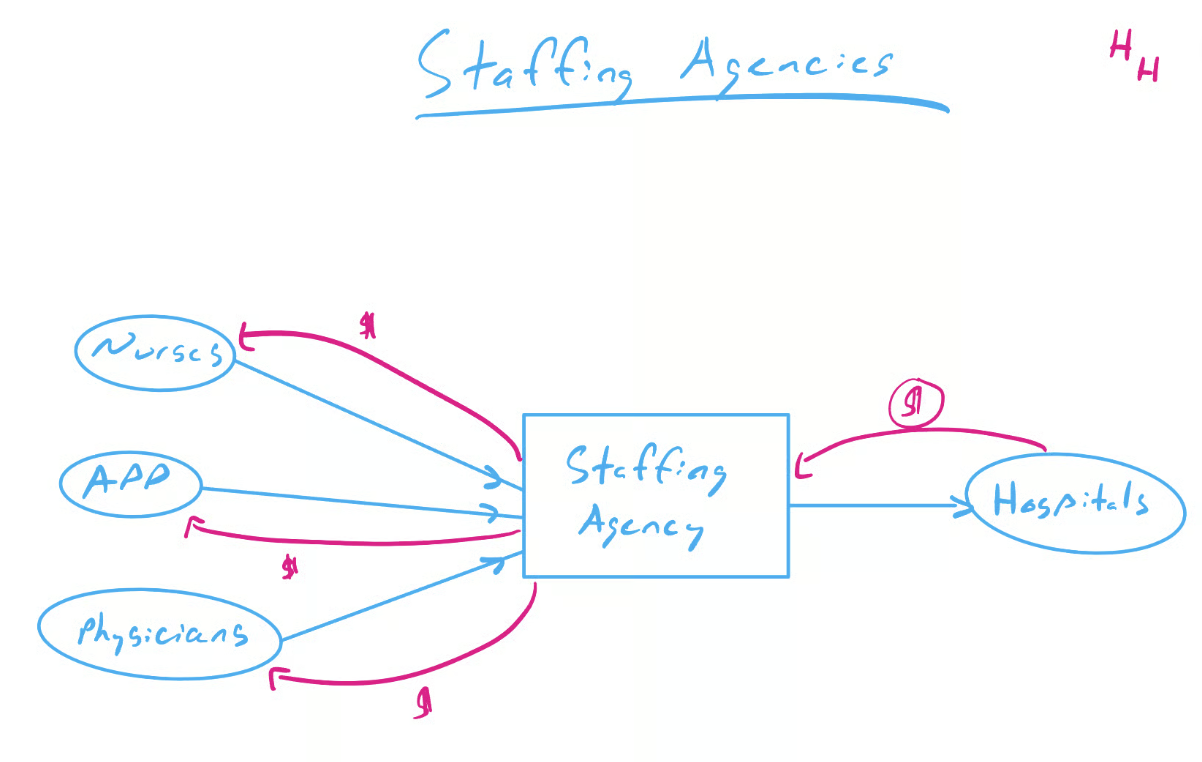
The agency handles screening, credentialing, and often payroll and benefits for temporary staff. This lets healthcare facilities avoid the administrative burden and risk of direct employment for short-term or fluctuating needs, while giving clinicians access to flexible work opportunities.
Agencies maintain large pools of pre-vetted clinicians, enabling hospitals to quickly fill vacancies caused by turnover, leaves of absence, seasonal spikes, strikes, or special projects.
Origin Story
The history of staffing agencies isn't particularly exciting. They emerged in the mid-20th century as healthcare demand grew, creating persistent staffing shortages and a need for workforce flexibility. Hospitals needed to maintain optimal staffing levels despite unpredictable patient volume. Over time, the industry evolved from basic placement services into sophisticated organizations offering credentialing, compliance management, and workforce analytics.
The staffing agency space remained relatively quiet until the pandemic, when it experienced explosive growth.
- Side note… it's funny—I remember writing about this years ago and was able to find old articles (if you're interested, see The Great Resignation and Large Health System Launches In-house Travel Nursing Agency).
The U.S. healthcare staffing market more than tripled during the pandemic—from $18.9 billion in 2019 to $68.7 billion in 2022. This was driven by urgent (if not emergent) demand for temporary clinical staffing as physicians, providers, and nurses left the profession from burnout. During 2021 alone, travel nurse revenue rose 162% from the previous year. Pre-pandemic, $1,400 per week was typical. During the pandemic, rates jumped to $5,000–$10,000.
Staffing firms had a field day. AMN Healthcare, for example, reported net income of $116 million in Q4 2021—a 1,100% increase year-over-year. Cross Country Healthcare's revenue doubled between 2020 and 2021, reaching $1 billion annually.
The windfall was so large that hospitals started accusing staffing agencies of price gouging. Some hospitals, like UPMC, took matters into their own hands and launched their own, in-house, staffing agency.
How the Money Flows
There are three main revenue models:
- Hourly markup model: the agency pays the recruited staff (physician, provider, or nurse) an agreed-upon hourly wage, then bills the healthcare facility a higher rate. For example, the staffing agency pays the nurse $40/hour, charges the facility $60/hour, and keeps the $20 difference.
- Flat fee model: the agency charges a one-time fee for each successful placement. This model simplifies budgets for hospitals but may limit agency profits on high-salary positions.
- Retainer model: hospitals pay agencies an upfront fee to secure ongoing recruitment services. This is helpful when nursing staffing is always tenuous.
Market Analysis
The healthcare staffing industry is substantial and growing. In 2024, the global market was valued at approximately $42.27 billion, projected to reach $82.92 billion by 2034, with North America (especially the US) as the largest market. The US market alone is estimated at $19.5 billion in 2024, expected to have grown to $20.62 billion in 2025.
Here are some of the top players:
- Aya Healthcare
- CHG Healthcare Services
- AMN Healthcare
- Cross Country Healthcare
- Jackson Healthcare
Impact Analysis
- Patients: The impact of staffing agencies on patient care is complex and depends on context. Heavy reliance on agency staff may hurt quality outcomes—particularly continuity of care, teamwork, and patient satisfaction—especially in resource-limited hospitals or when agency staff are unfamiliar with facility protocols. That said, agency and travel nurses can deliver safe care if hospitals provide proper onboarding and integration. Many agency nurses are experienced professionals who prepare thoroughly for assignments and help maintain care quality during staffing crises. Importantly, agencies help hospitals avoid dangerous understaffing, which is itself linked to poor patient outcomes.
- Physicians: Agency work offers flexibility, higher pay (especially during high-demand periods), and exposure to diverse practice settings. However, agency clinicians may face less job security, weaker integration into facility culture, and inconsistent support or orientation. These factors can affect job satisfaction and working conditions, though some clinicians value the autonomy and variety agency work provides.
- Health Systems: Staffing agencies let hospitals quickly fill critical gaps, reduce time-to-hire, and maintain operations during surges or crises. But agency labor is expensive—very expensive—and excessive reliance can strain hospital budgets and potentially hurt care quality. Strategic use of agency staff can help balance patient care needs with cost and quality, but overuse may signal deeper workforce management or retention problems.
Could We Live Without Them?
Some healthcare systems have tried to reduce reliance on third-party staffing agencies by creating internal staffing pools or “in-house agencies”—but most haven’t been able to eliminate agencies altogether. Internal staffing agencies (see UPMC above) can reduce costs and increase control, but they often can’t fully meet demand, especially during acute shortages or for specialized roles.
Other alternatives include directly hiring per diem staff, using technology-driven staffing platforms that connect clinicians directly with facilities (bypassing traditional agencies), and recruitment process outsourcing (RPO) models. However, these solutions don't offer the same scale, speed, or compliance assurance as established agencies—particularly during crises.
If staffing agencies disappeared, hospitals would struggle to rapidly source, credential, and deploy qualified staff, especially during surges or in rural and underserved areas. Many facilities would likely see increased burnout among permanent staff, higher turnover, and declining care quality and access. While some adaptation is possible, for the foreseeable future, staffing agencies remain integral to healthcare workforce management.
Overall, healthcare staffing agencies are essential to modern healthcare, providing hospitals with flexible, rapid staffing solutions for unpredictable demand, surges, and crises—capabilities difficult to replicate internally. The pandemic revealed both their high costs during shortages and their critical role when traditional hiring fails. Agencies solve urgent staffing needs but strain hospital budgets, offer physicians, providers, and nurses flexibility and higher pay but may reduce continuity and team cohesion, and affect patients depending on how well facilities integrate temporary staff.