
There is a Debate That Never Goes Out
Last week, at the Labour Party conference, Manchester’s third best Johnny Marr impersonator and current UK Prime Minister Andy Burnham announced a New National Care Service, promising that Labour would establish the service in the next parliament, providing free personal care for older people.
The aim is for it to be founded on the same principles as the NHS, where everyone contributes and everyone is covered. Adjusting the pensions triple lock from April 2030 will help fund it.
The last PM to moot scrapping the Triple Lock was Theresa May, who said she would reduce it from 2017, before doing away with it in 2020. It was part of a package of care reforms dubbed a ‘dementia tax’. She lost 13 seats, failed to maintain her majority, and after enduring a difficult 2 years, where a lack of majority, as well as a very divided post-Brexit nation, stymied most of her attempted policies, she resigned and was replaced by Dougal from The Magic Roundabout.
Five of the last eight Prime Ministers have mooted some kind of change. But you have to go back to NHS and Community Care Act of 1990 to find the last long lasting substantive change. The Kingsfund, as ever, has a beautiful report on this with a timeline on the bottom. Each block represents a policy, report, or budget where care was front and centre.
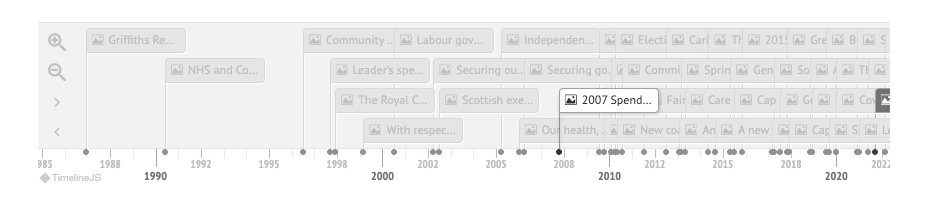
Recency bias of course plays a part, but the sheer number of reforms, tweaks, nudges and about-turns since the turn of the century compared to the previous 50 years is astounding.
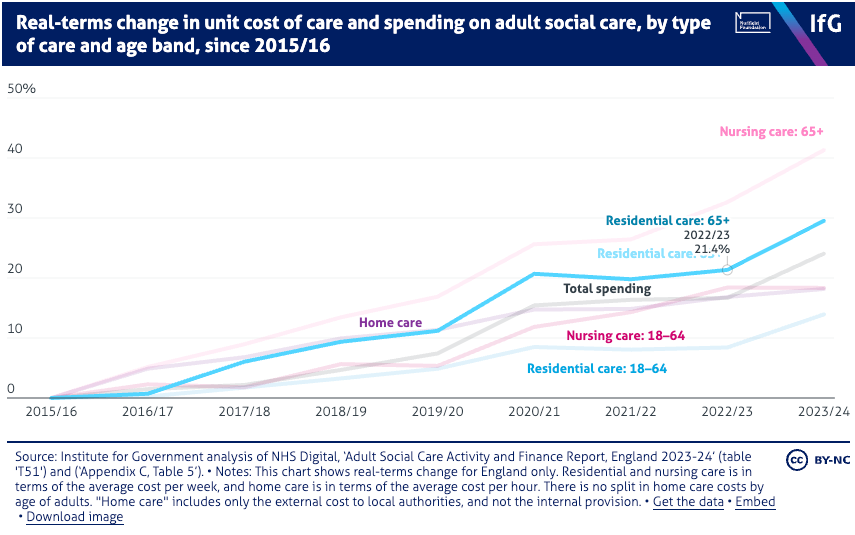
And yet in this time, in real terms, the cost of care has skyrocketed. The Institute for Government’s 2025 Care Performance Tracker shows the cost of care rose over 35% in the previous 8 years.
Spending on adult social care is dominated by the rising costs of care. Since 2015/16, the unit cost of delivering care has risen faster than economy-wide inflation (which sits at 36.8% to April 2025) in all settings and for both working age adults (aged 18 to 64) and older adults (aged 65 and over).
This means that local authorities have to spend more for the same level of care. Between 2019/20 and 2023/24, local authorities’ spending on long-term care rose by 17.1% in real terms.
But, as Bob Dylan still mumbles, the times they-are-a-changing. This time around mooted reforms to social care are not being met with cries of a ‘dementia tax’ but cries of ‘that’s going to cost us all more, we already pay too much tax’.
Everything comes back to the F word: Funding
That’s far too complex a question to answer in 1,500 words on a LinkedIn post. But what we can look at is what a National Care Service (as of this moment in time, it’s a name only) would potentially cost, versus what Social Care currently costs us.
It’s worth remembering that since 1990, care has been a statutory obligation for councils, both for adults and children.
As these costs rise and rise ahead of council revenues then other services need to be cut. Burnham has already talked about how protecting the NHS budget in the past has forced governments to cut other services, in turn increasing pressure on the NHS. A vicious cycle.
But for squeezed councils, these costs mean out go libraries. Out go Early Help services. Out go social groups for isolated adults. Out go all the ‘fluffy’ bits that improve society, as they are simply unaffordable whilst meeting the legal obligations to provide care.
So then we return, like a couple on a catastrophically bad first date, to the question of who foots the bill. The Triple Lock reform has been proposed.
But there is a fly in this Triple Lock ointment. The IFS reckon that it would save £4 billion a year by 2035 and £6 billion by 2040. But the cost will be circa around £7.5 billion a year from 2030, inevitably increasing year after year.
I’m no Hannah Fry, but that doesn’t look like it balances to zero. So surely, with a PM who knows ring fencing budgets at the expense of wider societal services, there’s some other money they have in mind.
What does care actually cost us now?
Apart from column inches and airtime, broken promises and U-turns so abrupt that they could have been soundtracked by Blazin’ Squad, the cost of care right now is sky high.
The maths below could best be described as ‘back-of-a-fag-packety’ but it’s important to note that if the original deficit from changing the Triple Lock is around £3.5 billion per year, nationalising social care could, or at least should, free up significant revenue, as well as increasing tax income for the Treasury.
So let’s break it down. Prepare your marker pen and packet of Marlboro Reds, it’s fag-packet-care-cost time. Please don't actually smoke. Or do maths on a packet of cigarettes. Highly inefficient. Both activies.
The NHS Knock On: +£2.7bn
Every day in England, over 13,000 people (larger than the population of Wells in Somerset) are stuck in hospital beds they don't need. Last year that added up to 6.75 million bed days lost to delays of a week or more according to Age UK.
According to the King’s Fund, at £562 a bed day, delayed discharge cost the NHS £2.7bn in 2025/26, up 7.5% in a year (King's Fund). Social care is already costing the NHS between £2.66bn (Age) and £2.7bn (King’s Fund) per year. About 1.3% of the total budget this year. What’s £40mn between friends? For a PM who has stated we mustn’t make the NHS the service of last resort, that is already a chunk.
Who Pays and What % of their Budget is it?: +£4.6bn
Councils, basically. And then families. The figures on the families are so wildly varied that after a couple of hours I gave up. They wouldn't be factored into this calculation anyway, as we're looking at where the centre could save.
So for councils: in 2025/26 they spent £27.4bn on adult social care and £16.9bn on children's. That's £44.3bn, or 31% of everything they spend on services. And they still overspent on adult social care by £715m accoding to good old ADASS.
Since 2009/10, per-person spending on social care is up 19% in real terms. Per-person spending on everything else is down 38%. Libraries are down 50%, youth services 60%, and children's centres and youth services combined 79%. This has severe societal impacts.
The net cost to society is unquantifiable. Nobody knows. MPs on the Health and Social Care Committee concluded last year that the Government hasn't costed the price of doing nothing, and told it to find out. This feels unusual, when everyone outside of those making money on this acknowledge it’s broken.*
What they could say int heir report is that taxpayers spend £32bn a year on adult social care, and that witnesses told them £6.1bn of investment would return £10.7bn in economic benefits. That's a £4.6bn net gain.
Obviously were care ripped out of councils hands, reversing 40 years of policy, council budgets would drop. By how much? Nobody has said, because nobody has done the maths. But a centralised service should get better value. You know, like the NHS does. Shut up.
Who profits? And where are they paying tax? - £?
Unsurprisingly with so much privatised care, the figures aren’t the easiest to come across. The Centre for Local Economics did a study showing that Private Equity owned care homes took in just three English regions took a tasty £256m in profit over three years. Those councils spent £3.8bn on care in 2024 alone.
Over a third of the companies in that report are either owned by private equity, registered in tax havens, or both. Where the tax ends up, the research doesn't say. The rest are owned by Real Estate Investment Trusts or mutuals/non profits. Private Equity's share is increasing.
I don’t think it would be brazen to suggest that the sentences ‘Private Equity owned entity registered in a tax haven’ and ‘Providing the quality of care one would like for their elderly or disabled relative’ are particularly comfortable bedfellows.
Unpaid Carers -£1.9bn
There are arguments that The National Care Service already exists. It's just unpaid.
Carers UK and the Centre for Care value it at £184.3bn a year, £20bn shy of a second NHS.
600 people a day leave work to do it. Every day. Multiply that by 365 and you end up at a number higher than Google’s reported GLOBAL workforce.
If each earnt the median UK pay of £32,890 (ONS, each one would have paid about £4,064 a year in income tax, using the frozen £12,570 allowance and the 20% basic rate.
So what does the state offer instead? The Carer's Allowance.
- £86.45 a week
- £4,495 a year for at least 35 hours of care
- Roughly £2.47 an hour.
And you can't earn more than £204 a week after tax to get it so anyone on median pay has to realistically stop working to qualify. Or work a maximum of 16 hours a week at minimum wage.
Would they all earn median wage? I suppose it’s why medians exist. Would they all go back into the workforce? No idea, and I’ve not got the time to ask 219,000 people a year that question.
Let’s assume 50% of them go back to full time roles, scribbling on the back-of-a-fag-packet, the state pays out a little more than the tax it forgoes.
The state spends about £4.5bn a year on Carer's Allowance. Put half of the UK’s estimated 900,000 carers claiming it back to work on median pay and the Treasury would collect roughly £2.6bn a year in income tax and National Insurance, or about £4.5bn once employer NI is counted. Would the National Care Service pay employer NI? The NHS isn’t, as many believe, exempt from Employers NI, it gets a rebate. Presumably the National Care Service would too? It's a minus figure according to the fag packet, of £1.9bn a year.
Human Cost - £?
Trying to quantify human cost in sterling is notoriously facile. So let’s do it anyway.
According to ADASS over 400,000 people are waiting for an assessment, care, a direct payment or a review.
About 2 million over-65s have some unmet need, including more than one in four over-80s according to our pals at Age UK.
The share of older people getting council-funded long-term care has fallen from 8.2% to 3.6% in 20 years and costs keep going up.
Vacancies sit at 6.2%, still around three times (2.1%) the wider economy. It’s hard, hard, fucking work, poorly paid, and with poor protections and hours.
The emotional cost, mental health cost, and everything else around it is virtually impossible to calculate. Any new system would come with it’s own challenges. Let’s call this one a score draw, because trying to quantity human suffering is a little bit Unit 731 of us. Don’t click that link if you want to have a nice remainder of the day.
Total: £5.4bn
The fag packet is covered in squiggles. Some up some down. In total it’s a +£5.4bn. The IFS identified gap from the Triple Lock was £3.5bn gap.
It is, of course, a completely nonsensical figure. But so many of our most impactful figures of the last 10 years are. If it’s mathematically defensible, delivered by the right orator, and PR’d properly, it works. A £350mn a week double decker bus is your best example. There are countless others.
It is so imminently PR-able: Centralised social care would save us money, and give councils more cash to spend on nice things like social services, repairing potholes, and whatever else is bouncing around the public’s frontal lobe that week.
Will care reform come?
Shrug Emoji. Who knows. Not I. Nor anyone else commentating on it.
Politician's syllogism is a term that comes from a 1988 episode of Yes, Minister. In essence it is ‘We must do something > This is something. >Therefore, we must do this.’ Bad reform does exist (Michael Gove used to be really good at it), which is why the Committee has been asked to look at the cost of doing nothing.
In other words, doing something is better than doing nothing. It is evident that the current English care system does not work for those who need it, or the wider general public. Ergo something, must be done. Yes, I just used 'ergo' in a public setting. Sue me.
The comms team Burnham has put together have done an undeniably brilliant job in the last few months, coming off a Starmer era that set the comms benchmark somewhere around -1/100.
This is perhaps their biggest challenge yet though. There are enough arguments above, that impact a large enough portion of society that they could and should be able to drive the message home.
The quality of care is stagnant, costs are skyrocketing, there aren't enough staff, and Private Equity is reaping the rewards. Framing this as a human argument ('Your beloved nan's inadequate care pays bankers bonuses' or 'a million people are forced out of work and into near poverty, because successive governments have funnelled money into the wrong hands' are absolute homeruns that even the most ardent of populists would struggle to argue against). Repeat them ad infinitum until they stick.
Communicating the benefits of social care reform eluded every government going back to Dilnot & the community care reforms of the 1990s. So pointing out the wider societal benefits and value for money that social care reform could bring will be crucial.
Is the country finally ready to accept care reform?
The PM has said it cannot be delayed any longer, but with any action pushed back to the next parliament, the question for This Charming Man, is How Soon Is Now?**
*Lovely little argumentum ad populum to undermine my own point.
**First person to count all 5 The Smiths puns in this article wins a Freddo. Just one mind, they’re 50p now.
One time Eurovision song contest judge and former Head of Audience for HLTH Europe (only one of those is true) Henry runs Keystone, an NHS Market Access agency, that also creates Narrative for healthtech startups. He finds writing about himself in the third person difficult, but writing about healthcare and healthtech joyful.
LinkedIn: www.linkedin.com/in/henrystoneley