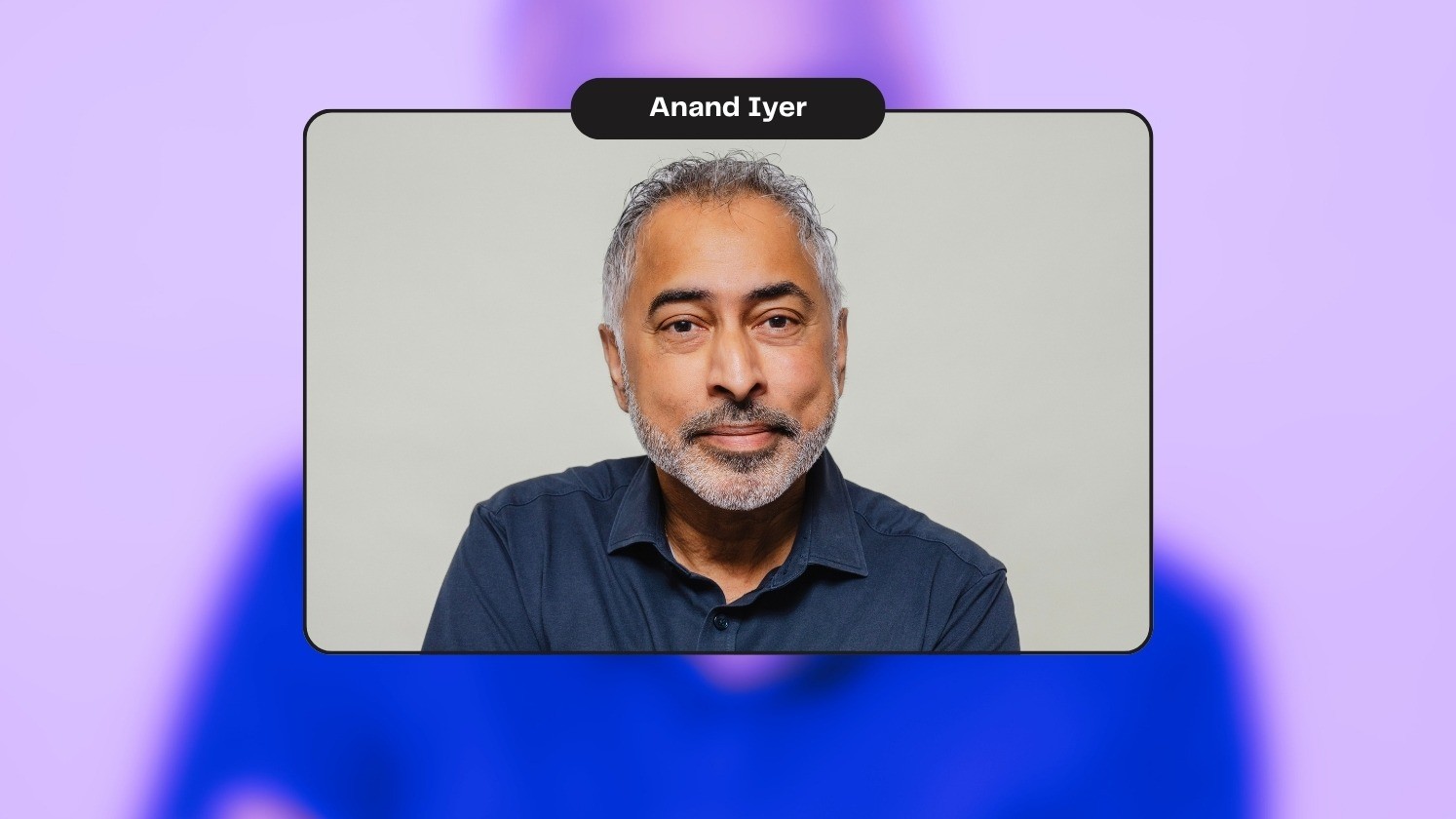

What kind of data actually powers Welldoc’s AI models, and how do you turn that data into clinically meaningful insights?
When we think about data and how it drives our AI systems, I often reference a framework a colleague shared recently at Wharton: RBC — Records, Business Logic, and Collective Intelligence. In digital health, that fits perfectly. It’s not just about collecting data; it’s about bringing together diverse inputs, adding intelligence and logic, and using the collective experience of many patients to support the one person in front of you.
Most healthcare AI fails because it's operating on a narrow slice of the patient journey. Humans don't live in datasets. We live through medications, meals, movement, sleep, symptoms, stress, and clinical interactions. That's why Welldoc brings together what we call MEDALS data every single day:
M for Medications
E for Education — videos watched, articles read
D for Diet
A for Activity and sleep
L for Labs — glucose, blood pressure, weight
S for Surveys and Symptoms, which are often semi-structured or unstructured
This heterogeneous data fuels everything we build. The algorithms I studied during my PhD — predictive modeling, nearest-neighbor analysis, pattern recognition — are all still relevant. For example, if we want to create the “next best action” for someone, we can look at a cohort of a hundred other patients who successfully improved. We analyze what they did, then measure the distance between those behaviors and where this patient is today. That’s how we guide them forward.
But of course, it can’t only be about analytics. We also have to zoom out: How do we ensure safety? How do we align with regulatory expectations? How do we deliver personalization without losing traceability? That balance — data, logic, collective intelligence, and disciplined engineering — is what makes the insights clinically trustworthy.
As Chief AI Officer—a role that didn’t exist in most organizations until recently—how do you see AI integrating across a company, and what does the job actually involve?
It’s funny—our CEO likes to say he gave me the title because it matches my initials: “A.I.” I told him I’m definitely using that line in future talks. But in reality, the Chief AI Officer role isn’t that different from any period when a disruptive technology enters an organization. You need direction, critical mass, and a framework for how to use that innovation responsibly across functions.
Most people assume AI is a technology discussion. In reality it's an organizational transformation discussion. I describe AI’s value in two parts: the denominator and the numerator.
The denominator is about efficiency—doing what we already do, but faster and more effectively. For example, a telemedicine doctor might spend an hour with a patient and two hours documenting notes. That’s unsustainable. With AI-driven ambient listening, the system can capture the dialogue, review charts and labs, and draft the clinical note automatically. The clinician just reviews and signs. That’s efficiency.
The numerator is novelty—things we couldn’t do before. If you’re wearing a continuous glucose monitor that records data every five minutes, AI can predict what your glucose will look like two hours from now and prompt you to take action in advance. That kind of proactive insight simply wasn’t possible before.
AI is only as good as the ecosystem surrounding it. Healthcare doesn't have a data problem. It has a connectivity problem. The future belongs to platforms that can seamlessly integrate wearable, clinical, pharmacy, and patient-generated data into a single actionable picture.
So my role is really connecting those numerator and denominator opportunities across the organization—product, marketing, finance, operations, regulatory—because AI touches them all. And it has to be done safely. This isn’t entertainment; it’s someone’s health. There must be a clear return on investment, governance, and regulatory discipline. A Chief AI Officer is part thinker, part doer, and part orchestrator.
Where do you see AI making the greatest impact in patient care today, and where do we need to be more cautious?
The most exciting part is outcomes. When patients with diabetes use our platform, their average hemoglobin A1C drops by 1.5 to 2 points—and in some cases, as much as 3 when combined with continuous glucose monitoring. For context, the FDA often approves a drug that lowers A1C by 0.5. We’re seeing improvements four, five, six times larger.
We also see reductions of 7 to 12 millimeters in systolic blood pressure, and 8 to 12% weight loss—meaningful for cardiometabolic health, but also for musculoskeletal and arthritic conditions. These are measurable, validated results achieved through AI-guided behavioral and clinical support.
The real unlock is personalization at scale. Historically, a doctor might prescribe 2,000 milligrams of metformin twice a day and tell you to come back in six months. But what if that drug simply isn’t right for you? AI allows us to tailor care based on your data, your patterns—sometimes even your genomic profile. It’s like a doctor in your pocket, but scalable.
Now, where do we need caution? Hallucinations. Generative AI models can produce information that looks right but isn’t grounded in fact. That’s unacceptable in healthcare. So we use the right type of AI for the right task. For high-risk clinical decision support—interpreting blood pressure or glucose data—we rely on rules-based AI. It’s deterministic and repeatable. No hallucinations. For engagement—education, conversational experiences—we can safely layer in generative AI.
So it’s about balance: the precision of rules-based AI with the adaptability of generative AI. The risks are real, but with rigorous validation, thoughtful design, and regulatory alignment, they’re manageable.
As the industry pushes toward real-world scale, what separates the companies getting closest from the rest? And what misconceptions still hold the field back?
The misconception is that generative AI equals clinical AI. It doesn’t. Public models are fantastic for drafting an email or brainstorming, but not for making clinical decisions. Regulated, evidence-based AI is a different category altogether—auditable, traceable, and built under FDA standards.
As for what differentiates the companies closest to true scalability, four things stand out.
First, a strong quality management system. In healthcare, quality has to sit at the top. You need clear processes for design, validation, risk management, regulatory alignment, and improvement.
Second, strong product management. The best companies translate customer and clinical needs into real product features that deliver measurable value. It sounds simple, but it’s not.
Third, continuous improvement. This industry can’t run on “set it and forget it.” The best organizations measure outcomes rigorously and create an always-on learning loop.
Finally, talent and culture. You need mission-driven people who can think creatively while operating within a regulated framework. We’ve built a young, incredibly bright data science team—people who don’t just think outside the box; half the time I’m not sure they know what the box is. Our job as leaders is to set the guardrails—privacy, security, regulatory discipline—and let them innovate within them.
At the same time, the industry suffers from too much noise and inflated claims. Regulators have already started stepping in. One bad actor can undermine trust for everyone. The way forward is simple: deliver signal over noise. Deliver outcomes, economic value, and engagement. Tell the truth about what your product can and can’t do.
For decades, healthcare has been reactive. We wait until people get sick, then intervene. AI gives us the opportunity to finally move upstream, anticipate risk, personalize support, and improve outcomes before complications occur. That's the future we're building toward.